Why Is Bariatric Surgery So Expensive?
{ if eq .Lang "zh" }{ else }{ end }Why does a one- to two-hour laparoscopic procedure cost as much as a used car? It’s the question almost every self-pay patient asks when they see a $14,000 quote for a gastric sleeve. The answer isn’t price gouging — it’s that the number you see covers a lot more than the time you’re on the operating table.
Bariatric surgery in the U.S. runs roughly $10,000 to $35,000 depending on the procedure. Let’s pull that figure apart so you can see exactly where the money goes.
Where the Money Actually Goes
The surgeon’s fee is often the smallest line item. The facility eats most of the cost.
| Cost Component | Typical Range | Share of Total |
|---|---|---|
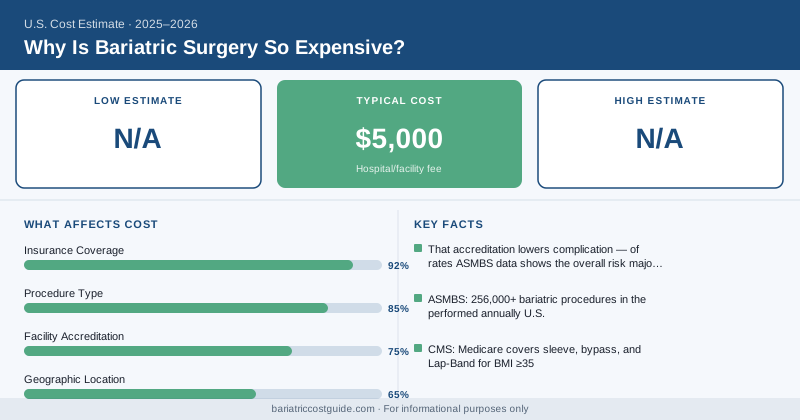
| Hospital/facility fee | $5,000 – $12,000 | ~50% |
| Surgeon fee | $2,500 – $5,500 | ~20% |
| Anesthesia | $1,000 – $2,500 | ~10% |
| Pre-op workup (labs, psych, nutrition) | $800 – $2,500 | ~10% |
| Post-op follow-up (first year) | $500 – $1,500 | ~10% |
That hospital fee covers the operating room, surgical staff, the laparoscopic stapling devices (which alone can run $1,500–$3,000 per case), recovery-room nursing, and your overnight stay. Operating-room time in the U.S. is often billed at $30–$100 per minute. The economics start to make sense.
The Five Cost Drivers
1. Facility and OR time. Hospitals carry enormous fixed costs — equipment, sterile supplies, 24/7 staffing. A specialized bariatric OR isn’t cheap to run, and that’s baked into every case.
2. The full surgical team. You’re not just paying one surgeon. There’s an anesthesiologist, surgical assistants, OR nurses, and recovery staff. Each bills separately.
3. Accreditation. Centers accredited by MBSAQIP (the ASMBS/American College of Surgeons quality program) maintain strict safety protocols and data tracking. That accreditation lowers complication rates — ASMBS data shows the overall risk of major complications is now under 4% — but maintaining those standards costs money.
4. Pre-op care you don’t see. Before surgery you’ll complete labs, imaging, a psychological evaluation, and nutrition counseling. Months of it. That’s all part of the package.
5. Disposable surgical hardware. Staplers, energy devices, trocars — single-use instruments add up fast in a stapled procedure like a sleeve or bypass.
Why a Bypass Costs More Than a Sleeve
Why Prices Vary So Wildly by Location
The same sleeve can cost $11,000 in Oklahoma and $25,000 in San Francisco. Hospital operating costs, real estate, local wages, and market competition all shift the number. Regional cost-of-living differences explain most of the spread — not surgeon skill.
Frequently Asked Questions
Why is it cheaper in Mexico? Lower hospital overhead, lower wages, and lower malpractice costs let Mexican bariatric centers charge $4,000–$8,000. The trade-off is harder follow-up access and variable accreditation — weigh that carefully.
Does the high cost mean it’s a rip-off? No. Bariatric surgery is one of the most cost-effective interventions for severe obesity. Studies show it often pays for itself within 2–4 years through reduced spending on diabetes, hypertension, and sleep apnea medications.
Why do self-pay and insurance prices differ? Self-pay “package” prices are often lower than the inflated “chargemaster” rates insurers negotiate against. Cash patients can sometimes get 20–40% off by paying upfront.
Is the surgeon’s fee really that small a part? Yes — typically only about 20% of the total. The facility fee is usually the largest single component.
Why do I pay for so many pre-op visits? Insurers and accredited centers require documented psych, nutrition, and medical clearance to reduce complication and readmission rates. It protects you, but it adds cost.
Can I lower the total? Get itemized quotes from 2–3 accredited centers, ask for the all-inclusive self-pay package, and explore financing options if you’re paying cash.
The Bottom Line
Bariatric surgery is expensive because the quoted price bundles a hospital OR, a full surgical team, single-use stapling hardware, accreditation standards, and months of pre- and post-op care — not just the surgeon’s time. The facility fee alone is usually half the bill. Knowing where the money goes is the first step to negotiating it down.
{ if eq .Lang "zh" }Disclaimer: BariatricCostGuide provides cost data for educational purposes only. We are not a medical provider, insurance company, or financial advisor. All costs are estimates based on published data and vary by location, facility, surgeon, insurance plan, and individual health factors. Consult a board-certified bariatric surgeon and your insurance carrier for personalized medical and cost advice.