Sleep Study Cost for Bariatric Surgery: What to Expect in 2025–2026
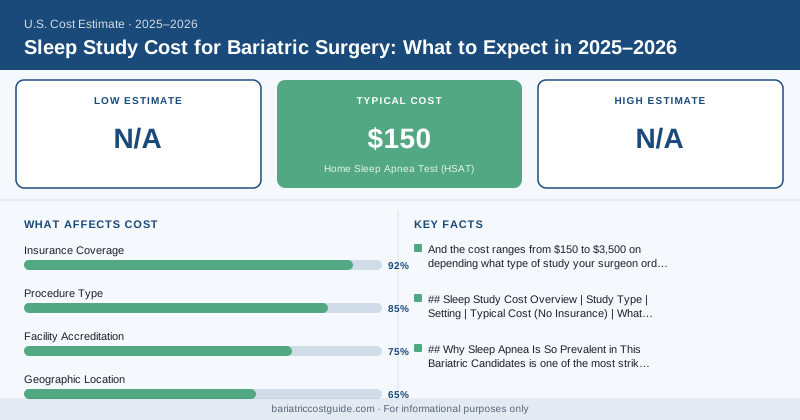
{ if eq .Lang "zh" }{ else }{ end }Before your bariatric surgery, your program may require you to be tested for sleep apnea. If you snore, feel unrefreshed after sleep, or wake up gasping, this isn’t bureaucratic box-checking — it’s medically necessary. And the cost ranges from $150 to $3,500 depending on what type of study your surgeon orders.
Here’s why it’s required and what it costs.
Sleep Study Cost Overview
| Study Type | Setting | Typical Cost (No Insurance) | What It Detects |
|---|---|---|---|
| Home Sleep Apnea Test (HSAT) | Patient’s home | $150 – $500 | Obstructive sleep apnea (OSA) |
| In-Lab Polysomnography (PSG) | Sleep center | $1,500 – $3,500 | OSA + other sleep disorders |
| Split-night PSG (diagnostic + titration) | Sleep center | $2,000 – $4,000 | OSA severity + CPAP pressure |
| CPAP titration study (if OSA already diagnosed) | Sleep center | $1,200 – $2,500 | Optimal CPAP pressure |
With insurance, most sleep studies are covered as medically necessary diagnostic testing. Patient out-of-pocket costs typically run $200–$800 after insurance, depending on your deductible and coinsurance.
Why Sleep Apnea Is So Prevalent in Bariatric Candidates
This is one of the most striking statistics in bariatric medicine: approximately 77% of bariatric surgery candidates have obstructive sleep apnea, according to research published by the NIH National Heart, Lung, and Blood Institute. And the majority are undiagnosed before they enter the bariatric evaluation process.
The physiology is direct. Excess adipose tissue around the neck, throat, and upper airway compresses the airway during sleep. With every 10 kg of weight gain, the risk of moderate-to-severe OSA increases substantially. BMI is the single strongest predictor of OSA severity in adults.
This prevalence matters for surgery for two reasons:
Undiagnosed OSA is an anesthetic risk. Patients with significant untreated sleep apnea are at higher risk for airway complications, hypoxia, and cardiac events during general anesthesia. Your anesthesiologist needs to know about it to plan appropriately.
OSA qualifies you for surgery. Under NIH guidelines, a BMI of 35–39.9 with obstructive sleep apnea qualifies a patient for bariatric surgery — the same as BMI ≥ 40 without comorbidities. Getting tested might be the thing that unlocks your insurance coverage.
Home Sleep Test vs. In-Lab Study: Which Does Bariatric Surgery Require?
Most bariatric programs accept either type of study, but individual programs and insurers may have preferences:
Home Sleep Apnea Test (HSAT):
- Done at home with a portable monitoring device
- Measures oxygen saturation, respiratory effort, airflow, and heart rate
- Adequate for diagnosing uncomplicated OSA in most patients
- Can’t diagnose other sleep disorders (central apnea, narcolepsy, REM behavior disorder)
- Much cheaper and more convenient than in-lab testing
In-Lab Polysomnography:
- Conducted at a sleep center with continuous monitoring overnight
- Gold standard for sleep disorder diagnosis
- Required by some bariatric programs for complex patients (prior cardiac events, significant cardiac arrhythmias, respiratory disease)
- Can diagnose the full spectrum of sleep disorders
- Approximately 10x the cost of a home test
The American Academy of Sleep Medicine (AASM) has endorsed home sleep testing as appropriate for most uncomplicated suspected OSA cases. If your bariatric program orders a home test and your results show moderate-to-severe OSA, that’s typically sufficient to meet surgical clearance requirements.
What the Results Mean for Surgery Timing
| OSA Severity (AHI) | CPAP Requirement Before Surgery | Typical Delay to Surgery |
|---|---|---|
| No OSA (AHI < 5) | None | No delay from this factor |
| Mild OSA (AHI 5–14) | CPAP sometimes required; varies by program | 0–4 weeks |
| Moderate OSA (AHI 15–30) | CPAP typically required before surgery | 4–8 weeks |
| Severe OSA (AHI > 30) | CPAP required; sometimes longer period | 4–12 weeks |
Programs typically want to see documented CPAP compliance (usually 70%+ use on 70%+ of nights for 30 days) before proceeding with surgery for patients with moderate-to-severe OSA. This delays the surgical timeline but reduces anesthetic risk.
Cost of CPAP If OSA Is Diagnosed Pre-Op
If your sleep study reveals OSA and CPAP is prescribed, you’ll need to budget for:
- CPAP machine: $600–$1,500 purchased; or $50–$100/month rental (usually through insurance’s DME benefit)
- Mask and accessories: $100–$300 initial; $200–$400/year replacement
- Follow-up compliance monitoring: $0–$200 (often managed through the CPAP machine’s data modem)
Most insurance plans cover CPAP as durable medical equipment (DME) with a compliance requirement. After demonstrating compliance (30–90 days of use), most insurers shift to covering CPAP supplies ongoing.
If Your Sleep Study Shows No OSA Despite Strong Symptoms
A negative home sleep test doesn’t always mean you don’t have sleep apnea. Home tests miss:
- Central sleep apnea (not obstructive)
- Position-dependent OSA (only supine)
- REM-specific OSA (occurs primarily during dream sleep)
- Upper airway resistance syndrome
If your HSAT is negative but you have significant symptoms (loud snoring, witnessed apneas, excessive daytime sleepiness, morning headaches), ask your bariatric program about ordering an in-lab polysomnography. A negative home test in the context of strong clinical suspicion isn’t the end of the diagnostic workup.
When the Sleep Study Works in Your Favor (Insurance)
If you’re in the BMI 35–39.9 range and your insurance requires a qualifying comorbidity to approve bariatric surgery, a newly diagnosed OSA case from your pre-op sleep study can literally open the door to surgical coverage.
This happens regularly. Patients who assumed they didn’t have sleep apnea get tested as part of bariatric pre-op and discover moderate-to-severe OSA. Their OSA diagnosis, combined with a BMI of 37, now meets the insurance criteria that unlocks coverage. The $300 HSAT becomes the thing that gets a $14,000 procedure covered.
The Bottom Line
A pre-op sleep study for bariatric surgery costs $150–$500 for a home test or $1,500–$3,500 for in-lab polysomnography. With insurance, your out-of-pocket is typically $200–$800. Given that 77% of bariatric candidates have OSA, and OSA can both increase surgical risk and qualify you for insurance coverage if you’re in the 35–39.9 BMI range, the sleep study is one of the highest-value steps in the pre-op process.
{ if eq .Lang "zh" }Disclaimer: BariatricCostGuide provides cost data for educational purposes only. We are not a medical provider, insurance company, or financial advisor. All costs are estimates based on published data and vary by location, facility, surgeon, insurance plan, and individual health factors. Consult a board-certified bariatric surgeon and your insurance carrier for personalized medical and cost advice.