Ozempic Cost: What You'll Pay Per Month With and Without Insurance
{ if eq .Lang "zh" }{ else }{ end }The retail price for Ozempic is $936/month. That’s the number that makes most patients hang up the phone.
But most people with type 2 diabetes who have commercial insurance aren’t paying anywhere near that. The Novo Nordisk savings card can bring it to $25/month for eligible patients. The challenge is knowing which bucket you’re in — and there are several.
What Ozempic Actually Costs
Ozempic (semaglutide) is FDA-approved for type 2 diabetes, not obesity. That distinction matters enormously for your costs.
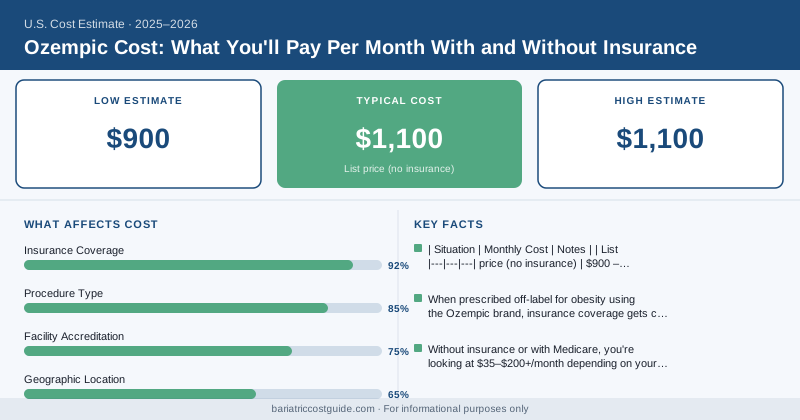
| Situation | Monthly Cost | Notes |
|---|---|---|
| List price (no insurance) | $900 – $1,100 | All doses similar in price |
| Commercial insurance, branded formulary | $25 – $150 | Savings card often applies |
| Medicare Part D | $35 – $200 | Savings card NOT usable with Medicare |
| Medicaid | $0 – $10 | If covered in your state |
| Novo Nordisk savings card (eligible) | $25/month | Up to 24 months |
The savings card program — officially called the “Ozempic Savings Offer” — caps out-of-pocket costs at $25/month for eligible commercially insured patients. You’re not eligible if you’re on Medicare, Medicaid, or any government-funded plan. Novo Nordisk’s prescribing information and savings card terms confirm this restriction.
What the Novo Nordisk Savings Card Covers
The savings card applies to all approved Ozempic doses: 0.25mg, 0.5mg, 1mg, and 2mg weekly injections. It’s a manufacturer coupon that offsets the copay or coinsurance gap between what your insurance pays and $25.
To use it, you need:
- A valid prescription from a licensed US prescriber
- Commercial insurance (employer-sponsored or marketplace)
- No government insurance (Medicare/Medicaid/TRICARE)
Some pharmacy benefit managers (PBMs) restrict manufacturer coupons — meaning CVS Caremark or Express Scripts might not accept them at certain pharmacy tiers. Always confirm with your specific pharmacy before counting on the $25 copay.
Why the Diabetes Indication Matters for Cost
Here’s the key issue: Ozempic is FDA-approved for type 2 diabetes. Wegovy is the same molecule (semaglutide) at a higher dose (2.4mg), approved for chronic weight management.
When prescribed off-label for obesity using the Ozempic brand, insurance coverage gets complicated:
- Commercial plans covering diabetes drugs may cover Ozempic for weight loss — but many specifically exclude it
- The savings card works regardless of indication for commercially insured patients
- Medicare explicitly prohibits manufacturer savings cards, and Part D plans have their own formulary rules
According to a 2024 KFF analysis, roughly 40% of large employer plans cover GLP-1 medications for obesity — but coverage for the diabetes indication (Ozempic) when used for weight loss is inconsistently applied. If your plan requires a diabetes diagnosis for coverage, using Ozempic without that diagnosis means full list price.
How to Check If Your Insurance Covers Ozempic
Don’t assume — call your pharmacy benefits line and ask:
- Is semaglutide (Ozempic) on my formulary? Ask for both the tier level and the estimated copay.
- Does coverage require a specific ICD-10 code? Type 2 diabetes (E11.xx) vs. obesity (E66.xx) can trigger different coverage rules.
- Is a prior authorization required? Most plans require PA for GLP-1 medications — your doctor needs to submit documentation.
- Does the savings card apply? Ask the pharmacist specifically if manufacturer coupons are accepted at your pharmacy.
Prior Authorization Hurdles
Most commercial plans require prior authorization before covering Ozempic. According to the American Diabetes Association’s 2024 standards, GLP-1 receptor agonists are recommended first-line for type 2 diabetes with cardiovascular risk factors — but the PA process still takes 1–4 weeks and can be denied on the first attempt.
Common PA requirements for Ozempic:
- Diagnosis of type 2 diabetes (not just obesity)
- A1C above a threshold (often 7.5–8.0%)
- Prior trial of metformin or documented intolerance
- Lab work within the past 6–12 months
If you’re seeking Ozempic specifically for weight management without a type 2 diabetes diagnosis, your doctor may need to appeal a denial or prescribe Wegovy instead — which has separate obesity-specific coverage considerations.
What If You Don’t Have Insurance or Coverage Is Denied?
At $900–$1,100/month without coverage, Ozempic is one of the more expensive ongoing medications in the US. Alternatives:
GoodRx coupons. GoodRx prices for Ozempic typically run $850–$950/month — a modest discount from list but not a major savings. GoodRx and manufacturer coupons cannot be combined.
Telehealth compounding pharmacies. Some online platforms prescribe semaglutide from compounding pharmacies at $200–$400/month. These are not FDA-approved branded products and quality varies significantly. The FDA has listed semaglutide as a drug in shortage, which has allowed compounding pharmacies to produce it legally — but that status can change.
Ozempic vs. Wegovy vs. compounded semaglutide. For pure weight loss without a diabetes diagnosis, Wegovy (FDA-approved for obesity) or a compounded semaglutide may make more practical sense given insurance coding rules.
The Long-Term Cost Reality
Ozempic is a chronic medication. Weight regain after stopping is well-documented — a 2022 NEJM study found participants regained two-thirds of their lost weight within one year of discontinuing semaglutide. That means this isn’t a 6-month commitment; it’s potentially a permanent treatment cost.
Over five years, Ozempic without insurance coverage costs $54,000–$66,000. That’s a meaningful comparison point if you’re evaluating it against surgical options — though the comparison gets more nuanced when insurance covers the medication and not the surgery (or vice versa).
For patients who qualify for bariatric surgery and want to compare long-term costs and outcomes, our GLP-1 vs. surgery 10-year comparison breaks down the numbers in detail.
Bottom Line
Commercially insured patients with a type 2 diabetes diagnosis can often get Ozempic for $25/month with the Novo Nordisk savings card — that’s genuinely affordable. Without insurance or with Medicare, you’re looking at $35–$200+/month depending on your plan, and $900–$1,100/month at full list price. The savings card is the difference-maker for most people, but it’s only available to commercially insured patients who aren’t on any government programs.
{ if eq .Lang "zh" }Disclaimer: BariatricCostGuide provides cost data for educational purposes only. We are not a medical provider, insurance company, or financial advisor. All costs are estimates based on published data and vary by location, facility, surgeon, insurance plan, and individual health factors. Consult a board-certified bariatric surgeon and your insurance carrier for personalized medical and cost advice.