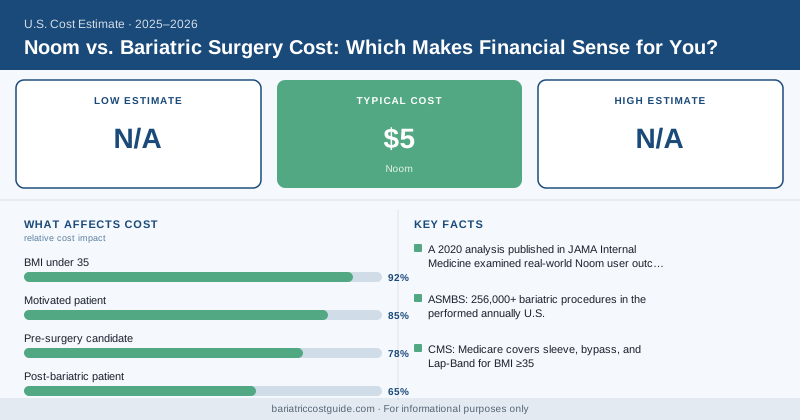
Noom vs. Bariatric Surgery Cost: Which Makes Financial Sense for You?
{ if eq .Lang "zh" }{ else }{ end }In 2010, a 300-pound adult trying to lose weight had roughly two options: diet and exercise, or surgery. Today there are apps, GLP-1 drugs, endoscopic procedures, and a dozen structured programs competing for the same patient. Noom, at roughly $200/year, is one of the most visible.
Bariatric surgery, at $15,000–$35,000+, is one of the most effective.
Which one is right for you financially — and medically — depends almost entirely on where you sit on the BMI and comorbidity spectrum. Let’s run the real comparison.
The Cost Gap Is Real — and So Is the Effectiveness Gap
| Approach | Year 1 Cost | 5-Year Cost | Average Weight Loss (% TBWL) | Maintained at 5 Years? |
|---|---|---|---|---|
| Noom | $170 – $220 | $850 – $1,100 | 5–8% TBWL | 30–50% maintain results |
| Weight Watchers (WW) | $200 – $300 | $1,000 – $1,500 | 4–6% TBWL | 30–40% maintain results |
| GLP-1 medications (Wegovy) | $6,000 – $18,000 | $30,000 – $90,000 | 15–17% TBWL | Requires continued use |
| Gastric sleeve | $10,000 – $23,000 | $12,500 – $28,000 (including ongoing costs) | 25–30% TBWL | 60–70% maintain at 5 years |
| Gastric bypass | $15,000 – $35,000 | $17,500 – $43,000 | 30–35% TBWL | 65–75% maintain at 5 years |
The data is clear: app-based programs like Noom produce clinically modest results for most users. A 2020 analysis published in JAMA Internal Medicine examined real-world Noom user outcomes and found average weight loss of approximately 5–7% of total body weight over 6 months among active users — with significant attrition in the sample. For a 250-pound person, that’s 12–17 lbs.
Bariatric surgery produces 25–35% total body weight loss (TBWL) that is largely maintained at 5 years for most patients. For the same 250-pound person, that’s 62–87 lbs.
Who Noom Actually Makes Sense For
Noom isn’t a bad product for the right user. It’s a psychology-informed behavior change program that teaches cognitive behavioral strategies around eating. For someone with BMI 27–33 and no serious comorbidities, it’s a reasonable first-line tool.
Where Noom makes financial and clinical sense:
- BMI under 35 with no major obesity-related conditions
- Motivated patient who hasn’t tried structured behavioral intervention yet
- Pre-surgery candidate using Noom to build behavioral skills before considering surgery
- Post-bariatric patient using it to maintain habits (not an uncommon use case)
Where Noom is insufficient:
- BMI 40+ — the absolute weight loss from app-based programs doesn’t meaningfully reduce cardiovascular, metabolic, or joint risks at this level
- Type 2 diabetes, sleep apnea, hypertension — conditions that respond dramatically to bariatric surgery but minimally to 5–8% weight loss
- History of multiple failed diet attempts — behavioral approaches have a 90%+ failure rate at 5 years for sustained major weight loss in patients with severe obesity
The GLP-1 Complication
Any Noom vs. surgery comparison in 2025 has to acknowledge GLP-1 medications. Wegovy (semaglutide) and Zepbound (tirzepatide) produce 15–22% TBWL — far outperforming Noom, approaching surgical sleeve territory. They’re changing the landscape.
But they cost $1,000–$1,400/month without insurance, require continuous use to maintain results, and have their own side effect profile. For someone who achieves good results on a GLP-1 and can maintain insurance coverage, the 5-year cost is still $60,000–$84,000 — more than double the cost of surgery.
The Hybrid Approach: Noom + GLP-1 Before Considering Surgery
An increasing number of obesity medicine specialists recommend a sequenced approach: start with behavioral intervention (Noom or similar) plus GLP-1 medication, evaluate results at 6–12 months, and then decide whether surgical candidacy makes sense.
Patients who lose 10–15% on GLP-1 therapy are often better surgical candidates — lower anesthesia risk, better nutritional status, and more developed behavioral skills. Insurance companies that require a 6-month supervised diet period are seeing GLP-1 prescriptions fill that window too.
Long-Term Maintenance: The Real Differentiator
Here’s the honest truth about diet programs: 95% of people who lose weight through diet alone regain most or all of it within 5 years. The NIDDK (National Institute of Diabetes and Digestive and Kidney Diseases) has published this figure for decades.
Bariatric surgery doesn’t guarantee permanent weight loss either — regain is real, and revision rates are non-trivial. But it produces significantly better long-term maintenance than behavioral interventions alone. The anatomical changes to your stomach create a structural reinforcement for portion control that apps can’t replicate.
For a patient deciding between Noom and surgery, the question isn’t really “which costs less right now?” It’s “which one will actually work for my specific situation over the next 10 years?”
The 5-Year Cost-Per-Pound-Lost Comparison
Let’s reframe the comparison in the unit that actually matters — cost per pound of sustained weight loss maintained at 5 years.
For a 280-pound patient targeting 80 lbs of sustained loss at 5 years:
- Noom: Achieves ~16 lbs average at 6 months; ~5 lbs sustained at 5 years. Cost: ~$1,000. Cost per pound of sustained loss: $200/lb
- Gastric sleeve (insured, $5,000 OOP + $8,000 ongoing): Achieves ~70 lbs; ~55 lbs sustained at 5 years. Cost: ~$13,000. Cost per pound of sustained loss: $236/lb
- Gastric sleeve (self-pay, $15,000 + $8,000 ongoing): Same outcomes. Cost: ~$23,000. Cost per pound sustained: $418/lb
Noom wins on pure cost-per-pound only because the denominator (sustained pounds lost) is so small that the math happens to work out. If you need — and can achieve — major sustained weight loss, surgery’s cost-per-unit-of-maintained-loss is competitive.
What to Tell Your Doctor
If you’re weighing Noom-type programs against surgical options, bring your full medical picture to the conversation:
- Current BMI and weight history over 10+ years
- Which comorbidities you have (diabetes, hypertension, sleep apnea, joint disease)
- Diet programs you’ve tried and results achieved
- Insurance coverage status for bariatric surgery
- Your willingness to commit to lifetime follow-up and supplementation
An obesity medicine specialist (board-certified through the Obesity Medicine Association) can assess all of these factors and recommend an appropriate treatment pathway — whether that’s Noom, a GLP-1, a referral to a bariatric surgeon, or a combination approach. Many hospitals now have weight management programs that offer all these options under one roof.
The 5-year financial picture almost always favors surgery for patients with significant obesity and comorbidities. For patients with modest excess weight and no comorbidities, behavioral programs remain first-line — and Noom is a decent one.
{ if eq .Lang "zh" }Disclaimer: BariatricCostGuide provides cost data for educational purposes only. We are not a medical provider, insurance company, or financial advisor. All costs are estimates based on published data and vary by location, facility, surgeon, insurance plan, and individual health factors. Consult a board-certified bariatric surgeon and your insurance carrier for personalized medical and cost advice.