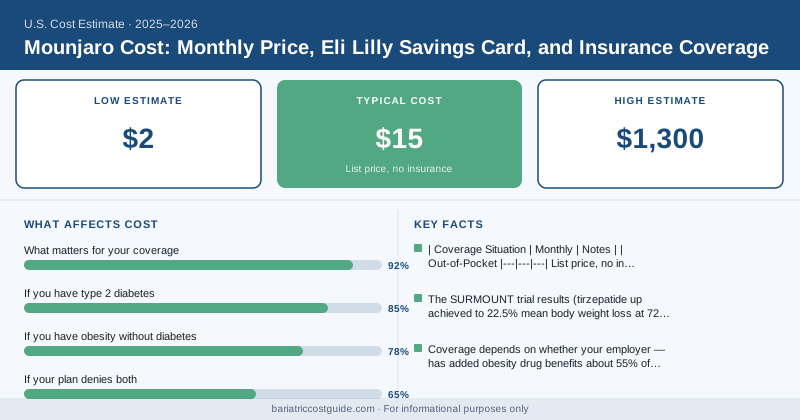
Mounjaro Cost: Monthly Price, Eli Lilly Savings Card, and Insurance Coverage
{ if eq .Lang "zh" }{ else }{ end }Most patients assume Mounjaro and Zepbound are interchangeable. They’re not — and that distinction costs some people thousands of dollars a year.
Both are tirzepatide. But Mounjaro is FDA-approved for type 2 diabetes; Zepbound is FDA-approved for obesity. Same molecule, different brands, wildly different insurance formulary positions. Here’s how the cost math works for each.
Mounjaro Pricing: The Full Picture
Mounjaro (tirzepatide injection, weekly) was approved by the FDA in May 2022 for type 2 diabetes. It works through dual GIP/GLP-1 receptor agonism — a different mechanism from pure GLP-1 drugs like semaglutide.
| Coverage Situation | Monthly Out-of-Pocket | Notes |
|---|---|---|
| List price, no insurance | $1,000 – $1,300 | All doses (2.5mg–15mg) similar price |
| Eli Lilly savings card (eligible) | $25/month | Commercially insured, non-government |
| Medicare Part D | $40 – $350 | Savings card not applicable |
| Employer plan, Tier 2 formulary | $50 – $200 | PA typically required |
| Medicaid | $0 – $20 | State-specific formulary coverage |
The Eli Lilly savings card for Mounjaro caps eligible patients at $25/month (up to 24 months in most program iterations). Eligibility mirrors other manufacturer programs: commercial insurance required, no government-funded coverage.
The Diabetes vs. Obesity Indication Problem
Here’s the complexity that catches patients off guard: Mounjaro is covered by diabetes-focused formularies; Zepbound is covered by obesity-focused formularies. If your employer plan covers diabetes drugs but excludes obesity drugs, you can get tirzepatide through Mounjaro with a diabetes diagnosis — but not through Zepbound for obesity alone.
Conversely, some plans now cover Zepbound for obesity but don’t consider Mounjaro for that indication. The SURMOUNT trial results (tirzepatide achieved up to 22.5% mean body weight loss at 72 weeks — published in NEJM 2022) led many insurers to add Zepbound to obesity drug formularies in 2023–2024.
What matters for your coverage:
- Your diagnosis code on the prescription
- Whether your plan covers the diabetes indication drug class (GLP-1/GIP agonists for T2D)
- Whether your plan has a separate obesity drug benefit
- Whether your PBM has tirzepatide on formulary under either brand
The FDA has not approved Mounjaro for obesity (that’s what Zepbound is for), so prescribing Mounjaro for weight loss without a diabetes diagnosis is technically off-label — which affects coverage.
Diabetes vs. Obesity: Which Indication Gets Better Coverage?
If you have type 2 diabetes: Use Mounjaro. Most commercial plans and many Medicare Part D plans cover it with prior authorization. The savings card brings it to $25/month for eligible patients.
If you have obesity without diabetes: Zepbound (or Wegovy) are the FDA-approved obesity options. Coverage depends on whether your employer has added obesity drug benefits — about 55% of large employers had by 2024 per KFF survey data.
If your plan denies both: Your doctor may prescribe Mounjaro off-label for obesity, but without a diabetes diagnosis, the savings card terms get complicated and coverage is unlikely. Consider comparing compounded tirzepatide options from licensed telehealth platforms.
Prior Authorization Requirements
Every major commercial insurer requires prior authorization for Mounjaro. Typical PA criteria:
- Diabetes diagnosis: HbA1c typically ≥ 7.0% or ≥ 7.5% (varies by plan)
- Previous medication trial: Most plans require documented trial of metformin first, unless there’s a contraindication
- Lab documentation: A1C, fasting glucose, renal function within 12 months
- Prescriber specialty or attestation: Some plans require endocrinology involvement for high doses
PA approval takes 5–14 business days. Denial is common on first submission — appeal rates succeed more often when your doctor includes SURMOUNT trial data showing superiority over other GLP-1s, particularly for patients with obesity and diabetes who haven’t reached A1C goals on other agents.
How Mounjaro Compares to Ozempic on Cost and Outcomes
Both are weekly injectables, both activate GLP-1 receptors, but tirzepatide also activates GIP receptors — which appears to drive its superior weight loss outcomes.
Direct head-to-head trial data (SURPASS-2, NEJM 2021): Mounjaro 5mg reduced A1C by 2.09 percentage points vs 1.86 for semaglutide 1mg. At 15mg, A1C dropped 2.46 points vs semaglutide’s 1.86 — a meaningful clinical difference for diabetes management.
For weight loss: SURMOUNT-1 found tirzepatide 15mg achieved 22.5% mean body weight loss vs 14.9% for semaglutide 2.4mg in the STEP-1 trial. That’s not a marginal difference.
The cost difference is modest — Mounjaro runs about $100–$200/month more than Ozempic at list price — but the efficacy advantage for both diabetes and weight management is real.
The Five-Year Cost Projection
At $25/month (savings card), Mounjaro over five years costs $1,500. Without the savings card or on Medicare, costs are $2,400–$4,200+/year depending on plan — totaling $12,000–$21,000 over five years.
At full list price: $60,000–$78,000 over five years. That’s the number that makes the cost comparison with bariatric surgery stark.
Bottom Line
Mounjaro at list price runs $1,000–$1,300/month. With the Eli Lilly savings card and commercial insurance, it’s $25/month — a completely different financial reality. The key is having a type 2 diabetes diagnosis for the Mounjaro indication; if you’re treating obesity only, your doctor may need to prescribe Zepbound (the obesity-approved version) for better insurance coverage. Prior authorization is almost universal — plan for documentation of A1C, prior metformin trial, and comorbidities.
{ if eq .Lang "zh" }Disclaimer: BariatricCostGuide provides cost data for educational purposes only. We are not a medical provider, insurance company, or financial advisor. All costs are estimates based on published data and vary by location, facility, surgeon, insurance plan, and individual health factors. Consult a board-certified bariatric surgeon and your insurance carrier for personalized medical and cost advice.