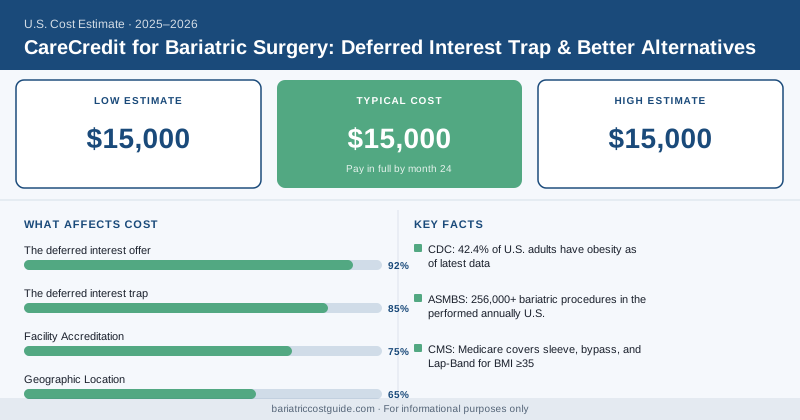
CareCredit for Bariatric Surgery: Deferred Interest Trap & Better Alternatives
{ if eq .Lang "zh" }{ else }{ end }The bariatric surgeon’s office says you’re approved and hands you a brochure for CareCredit. “It’s 0% interest for 24 months,” the coordinator says. What she doesn’t say — or says quietly — is that if you have even $1 unpaid at the end of those 24 months, you owe all the interest that accumulated since day one at 29.99% APR. That’s not a minor detail. For a $15,000 bariatric surgery, one bad month could cost you $4,500 in retroactive interest you thought you’d avoided.
How CareCredit Actually Works
CareCredit is a healthcare credit card issued by Synchrony Bank. It’s accepted at over 260,000 healthcare providers and is heavily marketed at medical offices, including many bariatric surgery programs.
The deferred interest offer:
- You apply for CareCredit at your bariatric program
- If approved, you charge your surgical costs to the card
- Synchrony offers “promotional financing” — typically 0% for 12, 18, or 24 months on purchases over certain minimums
- During the promotional period, no interest accrues IF you pay the full balance by the promotion end date
- Minimum monthly payments are required throughout the promotional period
The deferred interest trap:
- If you don’t pay the full balance by the promotion end date, you’re charged ALL of the interest that would have accrued from day one at the standard APR
- Standard CareCredit APR: 29.99%
- That interest is “deferred” — it was never forgiven, just suspended pending your on-time payoff
| Scenario | Balance | Result |
|---|---|---|
| Pay in full by month 24 | $15,000 | $0 interest — genuinely free |
| Miss payoff by $500 at month 24 | $15,000 | Potentially $4,500+ in retroactive interest added |
| Pay minimums only for 24 months | $15,000 | Significant balance remains + all accrued interest |
When CareCredit Actually Makes Sense
CareCredit isn’t always the wrong choice. It can work well when:
You can realistically pay the full balance within the promotional period — Do the math. If surgery costs $15,000 and you have 24 months to pay, that’s $625/month. Can you reliably pay $625/month for two years? If yes, CareCredit at 0% beats a personal loan at 8%.
You’re using it for smaller post-op expenses — Bariatric vitamins, compression garments, follow-up visits. A $500 charge on a 12-month 0% offer that you’ll definitely pay off is fine.
Your credit score qualifies you for the promotional offer — CareCredit promotional offers require decent credit (typically 650+). With good credit, you may have better options (see below), but CareCredit is accessible and fast.
The Break-Even Calculation
The Real Cost of Carrying a CareCredit Balance
If you carry a $15,000 balance and don’t pay it off during the promotional period:
- Year 1 at 29.99% APR: approximately $4,500 in interest
- Minimum payments keep you in debt for years while interest compounds
- Total cost of the “0% financing” could exceed $25,000–$30,000 before you’re debt-free
This is not a hypothetical. Consumer Financial Protection Bureau (CFPB) data has consistently shown that deferred interest products generate disproportionate revenue from consumers who miss the payoff deadline by small amounts.
Better Alternatives to CareCredit for Bariatric Surgery
1. Personal Loan from a Credit Union or Bank
Credit union members often qualify for personal loans at 6–12% APR — roughly half to a third of CareCredit’s rate. Unlike CareCredit, personal loans have fixed terms with amortized interest: you always know exactly how much you owe and when it ends. No retroactive interest surprises.
See our bariatric surgery loans guide for specific lenders including LightStream, Prosper Healthcare, and CapexMD.
2. LightStream Medical Loan
LightStream (SunTrust/Truist) offers unsecured personal loans for medical procedures at rates as low as 6.99–15.99% APR (2025 rates) for well-qualified borrowers. Fixed terms from 24–84 months. No fees, no prepayment penalty. For a $15,000 loan at 8% over 60 months, that’s $304/month — and the interest is real but predictable.
3. Hospital or Bariatric Program Payment Plans
Many bariatric surgery centers offer in-house payment plans, sometimes at 0% for 12 months (genuine 0%, not deferred interest) or low fixed rates. Ask specifically: “Is this deferred interest or true 0%?” See our payment plan guide.
4. HSA/FSA
If you have HSA or FSA funds, using them to cover bariatric costs is the best option — it’s genuinely free money (pre-tax savings of 22–37% depending on bracket). Read our HSA/FSA guide for how to maximize this.
5. CapexMD
CapexMD specializes in financing for elective and bariatric procedures. They offer loan amounts up to $40,000 with terms of 24–84 months and rates competitive with personal loan rates. Better suited for bariatric-specific needs than a general-purpose credit card.
| Option | APR Range | Interest Type | Risk Level |
|---|---|---|---|
| CareCredit 0% promo | 0% if paid in full; 29.99% if not | Deferred interest | High if not paid off |
| LightStream personal loan | ~7–16% | True interest (amortized) | Low |
| Credit union personal loan | ~6–15% | True interest (amortized) | Low |
| CapexMD medical loan | ~8–18% | True interest (amortized) | Low |
| Hospital 0% payment plan | 0% (if true 0%) | None | Low if confirmed |
| HSA/FSA | 0% (pre-tax savings) | None | Low |
If You Do Choose CareCredit
Set up automatic payments and calendar a reminder 60 days before your promotional period ends. At that point, verify your exact balance and ensure you have a plan to pay it completely. Don’t assume your minimum payments have covered enough — they almost certainly haven’t.
CareCredit is a tool. Like most financial tools, it’s fine when used correctly and expensive when it isn’t. For a $15,000–$30,000 bariatric surgery, the stakes are high enough that better options are usually worth the slightly more complex application process.
{ if eq .Lang "zh" }Disclaimer: BariatricCostGuide provides cost data for educational purposes only. We are not a medical provider, insurance company, or financial advisor. All costs are estimates based on published data and vary by location, facility, surgeon, insurance plan, and individual health factors. Consult a board-certified bariatric surgeon and your insurance carrier for personalized medical and cost advice.