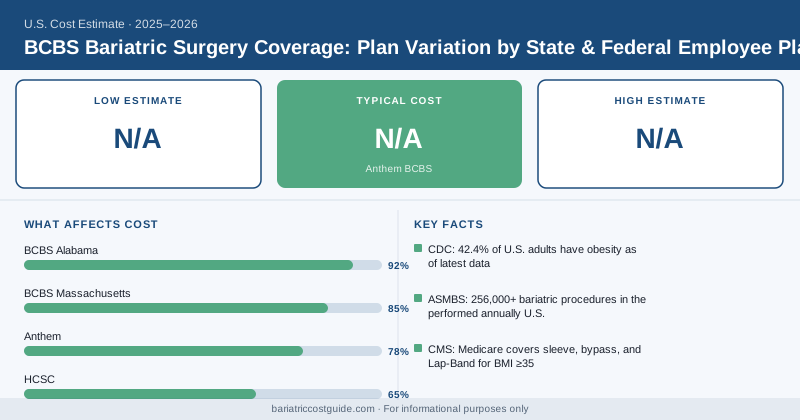
BCBS Bariatric Surgery Coverage: Plan Variation by State & Federal Employee Plans
{ if eq .Lang "zh" }{ else }{ end }“Blue Cross Blue Shield covers bariatric surgery” — you’ll hear this and feel relieved. Then you find out your specific Blue plan doesn’t. BCBS isn’t one insurer. It’s 35 independent companies operating under a licensing agreement. What BCBS of Texas covers, BCBS of North Carolina doesn’t have to. This guide breaks down how that patchwork actually works so you’re not blindsided.
The BCBS Federation: Why Your State Matters
The Blue Cross Blue Shield Association licenses the Blue brand to independent member companies. Each operates separately and sets its own medical policies. The practical result:
- BCBS Alabama may require a six-month supervised diet program
- BCBS Massachusetts (now Blue Cross Blue Shield of Massachusetts) has historically been more restrictive
- Anthem (which operates Blue plans in 14 states) has its own clinical policies
- HCSC (Blue plans in Illinois, Montana, New Mexico, Oklahoma, Texas) follows yet another set of guidelines
The ASMBS estimates that about 256,000 bariatric procedures were performed in the U.S. in 2023 — and roughly a third of those patients had BCBS coverage in some form, making it the single largest commercial payer block for bariatric care.
| BCBS Operator | States |
|---|---|
| Anthem BCBS | CA, CO, CT, GA, IN, KY, ME, MO, NV, NH, NY, OH, VA, WI |
| HCSC | IL, MT, NM, OK, TX |
| Highmark | DE, PA, WV, NY (western) |
| Cambia | ID, OR, UT, WA |
| BCBS of Michigan | MI |
| Others | Most remaining states |
Standard Coverage Criteria Across BCBS Plans
Despite the variation, most BCBS plans align on a common baseline drawn from the NIH criteria:
- BMI ≥ 40 — eligible without comorbidities
- BMI 35–39.9 — eligible with documented comorbidities (type 2 diabetes, hypertension, sleep apnea, cardiac disease, hyperlipidemia)
- Failure of non-surgical weight loss — almost always required; duration and documentation vary by plan
- Psychological evaluation — required by most plans
- Nutritional counseling — pre-op visits typically required
What varies by plan:
- How many months of supervised diet are required (three months to six months is the typical range)
- Whether the supervised diet must be with a physician or an RD qualifies
- Which specific procedures are covered (the band is increasingly excluded)
- Whether Centers of Excellence designation is required
Federal Employee Plans (FEHB)
If you’re a federal government employee, your coverage comes through the Federal Employees Health Benefits program, administered by OPM. BCBS offers two major FEHB options:
Blue Cross Blue Shield Service Benefit Plan (Federal Employee Plan / FEP) — This is the most common BCBS option for federal workers. The FEP covers bariatric surgery under its Standard Option, Basic Option, and FEP Blue Focus plans, but the specifics differ:
| FEP Plan Option | Bariatric Coverage |
|---|---|
| FEP Standard Option | Covered; prior auth required; in-network preferred providers |
| FEP Basic Option | Covered with similar criteria; often slightly higher cost-sharing |
| FEP Blue Focus | Limited network; check provider availability |
| FEP Green (newer) | Review current year OPM brochure |
The FEP plan brochure is published annually by OPM and is the authoritative source. Download the current year brochure from opm.gov — it will have explicit bariatric surgery language. According to KFF (Kaiser Family Foundation), federal employees represent about 8.2 million covered lives under FEHB, making it one of the largest group insurance pools in the country.
Federal Employee Tip
The Six-Month Supervised Diet Requirement
Anthem BCBS and HCSC both commonly require three to six months of physician-supervised weight management. Here’s what qualifies:
- Monthly documented visits with BMI, weight, and dietary compliance notes
- Supervised by a physician (MD or DO); some plans accept NP/PA with physician oversight
- Visits within the 24 months before surgery (some plans specify 12 months)
Prior Authorization Under BCBS
Prior auth is universal across BCBS plans for bariatric surgery. The process:
- Surgeon’s office submits PA request to your specific BCBS plan
- BCBS reviews against their clinical criteria (each plan publishes these; search “[Your BCBS Plan] bariatric surgery medical policy”)
- Approval, denial, or request for additional information
- Peer-to-peer review available if initially denied
Average approval timeline: two to four weeks at Anthem; three to six weeks at some other BCBS plans during high-volume periods.
What Procedures Does BCBS Cover?
Most BCBS plans cover:
- Roux-en-Y gastric bypass (RYGB)
- Vertical sleeve gastrectomy (VSG / gastric sleeve)
- Biliopancreatic diversion with duodenal switch (BPD/DS) — with additional documentation at many plans
Many BCBS plans are dropping or restricting:
- Adjustable gastric band (Lap-Band) — increasingly excluded or requiring extensive documentation
- Endoscopic sleeve gastroplasty (ESG) — still investigational at many BCBS plans
How to Find Your Specific BCBS Coverage
- Call the Member Services number on your BCBS insurance card — not a general Blue website
- Ask specifically: “Does my plan include a bariatric surgery benefit?” and “What is the clinical policy number for bariatric surgery so I can read the criteria?”
- Download your plan’s medical policy from your member portal (most BCBS plans publish these)
- Have your bariatric surgery program’s benefits coordinator do a formal verification — they know your specific plan’s quirks
The variation across BCBS plans is real and significant. Don’t assume coverage just because someone in your city has “Blue Cross” and got approved. Find out which specific Blue plan you have, which company administers it, and read that company’s actual medical policy.
{ if eq .Lang "zh" }Disclaimer: BariatricCostGuide provides cost data for educational purposes only. We are not a medical provider, insurance company, or financial advisor. All costs are estimates based on published data and vary by location, facility, surgeon, insurance plan, and individual health factors. Consult a board-certified bariatric surgeon and your insurance carrier for personalized medical and cost advice.