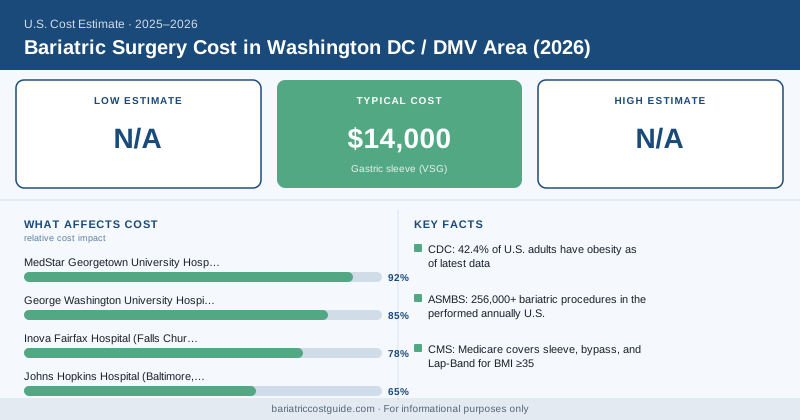
Bariatric Surgery Cost in Washington DC / DMV Area (2026)
{ if eq .Lang "zh" }{ else }{ end }The DC metro — the DMV (DC, Maryland, Virginia) — has one of the highest concentrations of federal government employees, contractors, and their families of any metro area in the country. For bariatric patients, that matters because most federal employees are on FEHB plans, and FEHB is one of the better insurance ecosystems for bariatric surgery in the US. Most major FEHB plans cover weight loss surgery — the question is documentation and pre-authorization, not eligibility.
On price: the DMV market is expensive. Gastric sleeve self-pay starts around $20,000 in the DC area and climbs to $35,000+ at Georgetown or GWU’s academic programs. This is a market where having insurance isn’t just helpful — it’s almost financially necessary. Self-pay in the DC metro is among the highest-cost propositions for bariatric surgery in the US.
DC/DMV Area Bariatric Surgery Prices (2026)
| Procedure | DC / Inner Suburbs | Northern Virginia (Inova) | Maryland Suburbs / Hopkins | National Average |
|---|---|---|---|---|
| Gastric sleeve (VSG) | $22,000 – $35,000 | $20,000 – $31,000 | $21,000 – $33,000 | $14,000 – $23,000 |
| Gastric bypass (Roux-en-Y) | $26,000 – $39,000 | $23,000 – $34,000 | $25,000 – $37,000 | $18,000 – $28,000 |
| Duodenal switch | $33,000 – $48,000 | $29,000 – $42,000 | $31,000 – $46,000 | $22,000 – $35,000 |
| Mini gastric bypass | $24,000 – $33,000 | $21,000 – $29,000 | $23,000 – $32,000 | $17,000 – $25,000 |
| Revision surgery | $30,000 – $50,000 | $27,000 – $44,000 | $29,000 – $48,000 | $20,000 – $35,000 |
Northern Virginia (primarily Inova Health System) is slightly less expensive than DC proper or the Maryland academic programs — making Inova Fairfax the rational first-choice for most commercially insured Northern Virginia residents. DC’s academic hospitals charge the highest prices in the region, justified only for patients with complex medical needs.
Major Bariatric Programs in the DC/DMV Area
MedStar Georgetown University Hospital (Washington, DC) MedStar Georgetown’s bariatric surgery program is one of DC’s major academic options. Georgetown’s program benefits from its affiliation with Georgetown University Medical Center and handles complex metabolic and revisional cases alongside routine primary bariatric surgery. Self-pay sleeve pricing runs approximately $25,000–$35,000. MedStar is in-network with most FEHB plans — including BCBS Federal (Service Benefit Plan) and Aetna FEHB — which matters for the large federal workforce in DC proper.
George Washington University Hospital (Washington, DC) GWU Hospital’s Weight Loss Surgery Center is affiliated with the George Washington University School of Medicine. GWU’s program is MBSAQIP-accredited and serves DC and close-in Maryland and Virginia suburbs. Self-pay pricing runs $22,000–$34,000 for sleeve. GWU tends to serve a more diverse patient population than Georgetown due to its location and safety-net hospital characteristics.
Inova Fairfax Hospital (Falls Church, Virginia) Inova is the dominant health system in Northern Virginia and a major bariatric option for the entire DMV market. Inova Fairfax’s bariatric surgery program is MBSAQIP-accredited, high-volume, and well-positioned in the Northern Virginia FEHB network. Self-pay sleeve pricing at Inova runs approximately $20,000–$30,000. For patients with BCBS Federal, UnitedHealthcare FEHB, Aetna FEHB, or Cigna FEHB plans in Northern Virginia, Inova is typically in-network and is the most common program used by the region’s large federal contractor employee population.
Johns Hopkins Hospital (Baltimore, MD) Johns Hopkins is 40 miles from DC and often overlooked by DC-focused searchers. Hopkins’s bariatric surgery program is MBSAQIP-accredited and one of the most academically respected on the East Coast. Self-pay pricing at Hopkins runs $24,000–$36,000. Hopkins’s real advantage over DC programs is for complex cases — revisional surgery, significant metabolic complexity, or patients whose primary care physician has already been managing them through Hopkins. The commute from DC proper (1 hour via MARC train or I-95) is manageable for a planned procedure.
University of Maryland Medical Center (Baltimore, MD) UMMC’s bariatric surgery program is the academic alternative to Hopkins on the Maryland side. Pricing runs $20,000–$31,000 — somewhat below Hopkins. UMMC serves a large Maryland Medicaid population and is experienced with the full spectrum of payer types. For Maryland residents in Prince George’s County or southern Maryland, UMMC in Baltimore is often a more accessible option than DC’s academic programs.
Sibley Memorial Hospital / Johns Hopkins Medicine (Washington, DC) Sibley Memorial Hospital in northwest DC is part of the Johns Hopkins Medicine system. Its bariatric program brings Hopkins-affiliated quality to a DC-proper location. Pricing is somewhat lower than Hopkins’s main Baltimore campus: approximately $21,000–$32,000 for sleeve.
Federal Employee Health Benefits (FEHB) Coverage
FEHB is the health insurance system for federal government employees, retirees, and eligible family members — currently covering approximately 8 million enrollees, according to the US Office of Personnel Management. For DMV-area patients, FEHB is the most important payer to understand.
Most FEHB plans cover bariatric surgery at MBSAQIP-accredited programs. The key plans and their general approach:
- BCBS Service Benefit Plan (the largest FEHB plan) — Covers bariatric surgery at MBSAQIP-designated Centers of Excellence. Requires pre-authorization, documented comorbidities, and 3–6 months of physician-supervised weight management. Available under both the Standard and Basic options.
- Aetna FEHB — Covers bariatric surgery with standard clinical criteria. In-network coverage requires MBSAQIP accreditation. Prior auth required.
- UnitedHealthcare FEHB (Choice Plus, Navigate) — Covers bariatric surgery; specific plans vary. Network coverage at MBSAQIP centers.
- Cigna FEHB — Covers bariatric surgery with pre-authorization and documented supervised diet period.
- GEHA (Government Employees Health Association) — Covers bariatric surgery at MBSAQIP programs. GEHA is the third-largest FEHB plan by enrollment.
The critical distinction: FEHB covers the federal employee and dependents — but if you’re a federal contractor employee (not a direct government employee), your insurance is whatever your contractor employer provides, not FEHB.
FEHB Open Season and Bariatric Surgery Timing
DC Medicaid and Maryland/Virginia Medicaid in the DMV
The DC/DMV area straddles three Medicaid jurisdictions:
DC Medicaid (District of Columbia Alliance / DC Health Alliance) — DC Medicaid covers bariatric surgery for qualifying adult enrollees. DC has among the most generous Medicaid programs in the country, with income eligibility thresholds higher than most states. DC Medicaid is administered directly by the DC government, not through traditional managed care in all cases.
Maryland Medicaid (HealthChoice) — Maryland is an ACA expansion state with full bariatric coverage for qualifying enrollees. Standard BMI and comorbidity criteria apply. HealthChoice managed care plans operate throughout Maryland including the DC suburbs.
Virginia Medicaid — Virginia expanded Medicaid in January 2019. Standard coverage criteria apply. Inova Fairfax and VCU Health both accept Virginia Medicaid for bariatric surgery. See our separate Virginia bariatric surgery cost guide for detail.
Self-Pay Strategies for DMV Patients
The DC metro is not the place to shop for bariatric surgery if you’re uninsured. But if you’re in that situation:
Northern Virginia is cheaper than DC proper. Inova Fairfax’s self-pay pricing is typically $3,000–$5,000 below Georgetown or GWU for the same accreditation tier.
Baltimore is 40 miles away and can be $4,000–$6,000 cheaper than DC academic programs. UMMC in particular offers competitive pricing for a major academic medical center.
Consider programs further afield. Richmond (VCU Health, Bon Secours) is 2 hours south of DC on I-95. Self-pay sleeve in Richmond runs $16,000–$24,000 — meaningfully below DMV prices.
For detailed guidance on navigating insurance approval, see bariatric surgery insurance coverage. For Medicare specifically (relevant for federal retirees), see Medicare bariatric surgery coverage.
{ if eq .Lang "zh" }Disclaimer: BariatricCostGuide provides cost data for educational purposes only. We are not a medical provider, insurance company, or financial advisor. All costs are estimates based on published data and vary by location, facility, surgeon, insurance plan, and individual health factors. Consult a board-certified bariatric surgeon and your insurance carrier for personalized medical and cost advice.