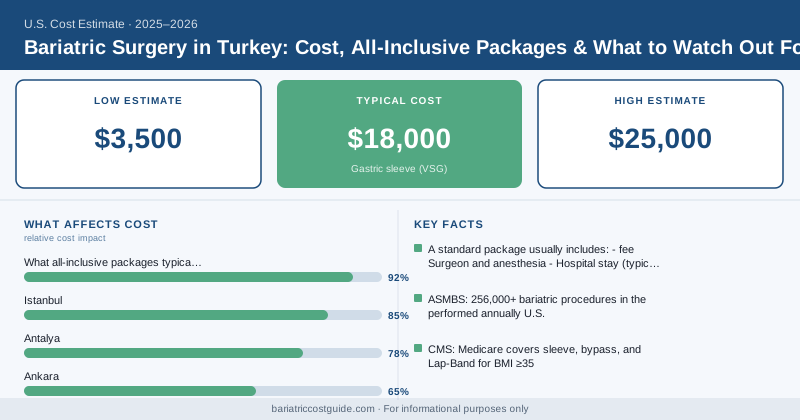
Bariatric Surgery in Turkey: Cost, All-Inclusive Packages & What to Watch Out For
{ if eq .Lang "zh" }{ else }{ end }Turkey has become the unlikely capital of medical tourism — and nowhere is that more evident than in bariatric surgery. Istanbul alone now performs an estimated 35,000+ weight loss surgeries per year on international patients, mostly from the UK, Germany, and the Middle East but increasingly from the US. The pitch is hard to ignore: gastric sleeve surgery, hotel accommodation, airport transfers, pre-op labs, and follow-up care — all bundled for $4,200. That’s what “all-inclusive” means in the Istanbul market.
The question isn’t whether Turkey is cheap. It’s whether cheap translates to safe.
What Bariatric Surgery Costs in Turkey
| Procedure | Turkey Package Price (All-Inclusive) | US Cash Price (Uninsured) |
|---|---|---|
| Gastric sleeve (VSG) | $3,500–$5,500 | $18,000–$25,000 |
| Gastric bypass (RYGB) | $5,000–$7,000 | $23,000–$35,000 |
| Mini gastric bypass | $4,500–$6,500 | $20,000–$28,000 |
| Gastric band (Lap-Band) | $3,000–$4,500 | $14,000–$20,000 |
| Duodenal switch | $6,000–$9,000 | $25,000–$40,000 |
| Revision surgery | $5,500–$8,500 | $25,000–$45,000 |
These are package prices that the major Istanbul and Antalya hospital networks advertise. Istanbul dominates — roughly 70% of Turkey’s medical tourism bariatric volume runs through hospitals in Istanbul’s European and Asian sides.
What “All-Inclusive” Typically Covers
The all-inclusive model is Turkey’s selling point. A standard package usually includes:
- Surgeon fee and anesthesia
- Hospital stay (typically 3–5 nights for sleeve, 4–6 nights for bypass)
- Pre-operative labs: CBC, metabolic panel, coagulation studies, ECG
- Upper GI scope (many programs include this)
- Post-op care and dressings during in-country stay
- Airport transfers and hotel-to-hospital transfers
- One or two nights in a partner hotel for arrival/departure
What all-inclusive packages typically do NOT include:
- International flights
- Hotel stays beyond the included nights (most packages include 1–2 nights; actual recovery often requires 5–7+ nights)
- Travel insurance and international health insurance
- Any revision or re-operation for complications
- Post-op vitamin and supplement supply
- The psychological evaluation (some programs add this fee separately)
- Any additional labs or imaging discovered to be needed during pre-op screening
Your true all-in cost with flights and hotel: $5,500–$10,000 from the US East Coast. Still less than half of US uninsured pricing.
Main Hospital Clusters
Istanbul — The primary destination. Key areas: Şişli, Levent, and Kadıköy have the highest concentration of private hospitals. Major names in the Istanbul bariatric market include Memorial Hospital Group, Acıbadem Healthcare Group, and Florence Nightingale Hospital. Acıbadem has JCI accreditation at multiple locations.
Antalya — Turkey’s second-largest medical tourism hub, often offering lower prices than Istanbul. Less accessible from the US (requires connection through Istanbul), but some packages include this routing. Several private hospitals with English-speaking staff.
Ankara — Turkey’s capital has major hospitals (Ankara City Hospital, several private chains) but is less marketed to international patients than Istanbul.
JCI Accreditation in Turkey
The Turkish Bariatric Market: Quality Range
Turkey’s bariatric market has a severe quality spread. At the top are sophisticated, JCI-accredited urban hospitals with internationally trained surgeons performing hundreds of cases per year. At the bottom are small private clinics that function essentially as brokers, outsourcing surgery to whichever surgeon accepts the day’s patients.
The UK’s National Health Service and medical regulators have issued specific guidance warning British patients about Turkey bariatric surgery complications — not because Turkish hospitals are uniformly poor, but because the low-end of the market has generated significant complication cases. In 2022, NHS England reported treating more than 100 patients for serious complications following bariatric surgery in Turkey, many at facilities with no meaningful accreditation or English-language post-op support.
The answer is not “don’t go to Turkey.” The answer is: only go to a JCI-accredited, high-volume facility with a credentialed bariatric surgeon.
What to Check Before Booking
1. Hospital JCI accreditation. Non-negotiable. Verify at jcrinc.com or jointcommissioninternational.org — don’t rely on the hospital’s website.
2. Surgeon’s individual credentials. Ask for the bariatric surgeon’s CV — Turkish Board of Surgery certification, fellowship training, case volume. Top Turkish bariatric surgeons have trained at European centers and published case series.
3. Complication protocol. Ask specifically: what happens if I have a leak, bleed, or other complication? Where will I be taken? Is there an ICU? Are there 24-hour surgical coverage?
4. What’s excluded from the package. Get the full scope in writing. Surprises at checkout are common in the all-inclusive market.
5. Post-return follow-up plan. Who manages your care back in the US? Some Turkish programs have partnered telemedicine services; others provide only email communication. You need a US physician willing to manage your post-bariatric care.
Currency and Timing Considerations
Turkey’s lira (TRY) has been highly volatile. Most medical tourism prices are quoted in USD or EUR to protect against currency fluctuation — but verify this in your contract. A package quoted in TRY at a favorable exchange rate can look different after a currency swing.
The best time for US patients logistically: fly into Istanbul, use the included airport transfer, do your pre-op day, have surgery, recover in-hospital, then spend 4–5 days in a hotel before flying home. Total trip: 10–14 days minimum for gastric sleeve; 12–16 days for bypass.
For comparison with other low-cost destinations, see bariatric surgery in Mexico, bariatric surgery in India, and the broader bariatric surgery abroad cost guide. If you’re still considering US options, bariatric surgery financing options can bridge the cost gap without international travel.
{ if eq .Lang "zh" }Disclaimer: BariatricCostGuide provides cost data for educational purposes only. We are not a medical provider, insurance company, or financial advisor. All costs are estimates based on published data and vary by location, facility, surgeon, insurance plan, and individual health factors. Consult a board-certified bariatric surgeon and your insurance carrier for personalized medical and cost advice.