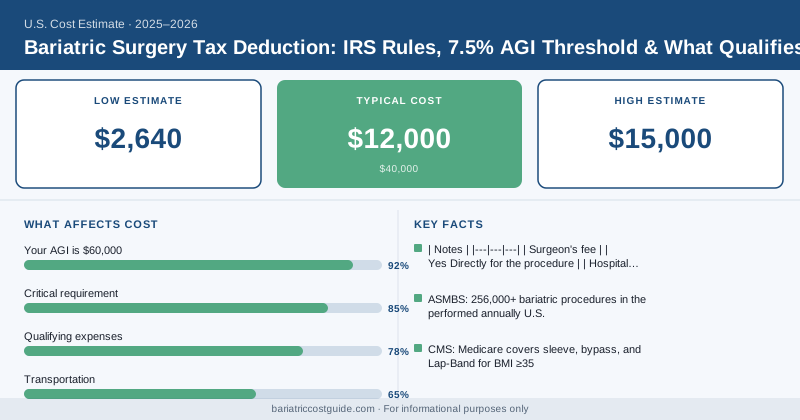
Bariatric Surgery Tax Deduction: IRS Rules, 7.5% AGI Threshold & What Qualifies
{ if eq .Lang "zh" }{ else }{ end }In 2010, the IRS officially clarified that weight loss surgery performed for a diagnosed medical condition qualifies as a deductible medical expense under IRC Section 213. That ruling matters if you’re self-paying for surgery this year — but only if your total medical expenses exceed 7.5% of your adjusted gross income (AGI). That threshold is the reason most people can’t actually use this deduction, even when their surgery is technically deductible.
The 7.5% AGI Floor: How It Works
Medical expenses are deductible only to the extent they exceed 7.5% of your AGI. Here’s what that means in practice:
- Your AGI is $60,000 → 7.5% threshold = $4,500
- If your total qualifying medical expenses for the year are $20,000, you can deduct $20,000 − $4,500 = $15,500
- That $15,500 is the deductible portion, which reduces your taxable income
- At a 22% tax bracket, that saves you $15,500 × 22% = $3,410 in federal taxes
| AGI | 7.5% Floor | Medical Expenses | Deductible Amount | Tax Savings (22%) |
|---|---|---|---|---|
| $40,000 | $3,000 | $15,000 | $12,000 | ~$2,640 |
| $60,000 | $4,500 | $18,000 | $13,500 | ~$2,970 |
| $80,000 | $6,000 | $20,000 | $14,000 | ~$3,080 |
| $100,000 | $7,500 | $22,000 | $14,500 | ~$3,190 |
| $150,000 | $11,250 | $18,000 | $6,750 | ~$1,485 |
Critical requirement: You must itemize deductions on Schedule A to claim medical expenses. With the standard deduction at $14,600 (single, 2025) and $29,200 (married filing jointly, 2025), itemizing only makes sense if your total itemized deductions — medical expenses plus state/local taxes plus mortgage interest — exceed the standard deduction.
For many people, the medical expense deduction alone won’t push them over the itemization threshold. But in a year you have bariatric surgery, significant other medical costs, plus mortgage interest and state taxes, itemizing may become worthwhile.
What Bariatric Expenses Qualify Under IRS Publication 502
IRS Publication 502 (Medical and Dental Expenses) is the authoritative guide. It explicitly recognizes weight loss surgery for a diagnosed medical condition as a deductible expense.
Qualifying expenses:
| Expense | Qualifies? | Notes |
|---|---|---|
| Surgeon’s fee | Yes | Directly for the procedure |
| Hospital or surgery center fees | Yes | Facility charges |
| Anesthesiologist fee | Yes | Part of surgical care |
| Pre-op diagnostic tests (labs, sleep study, EKG) | Yes | Required medical testing |
| Pre-op physician consultations | Yes | PCP clearance, specialist visits |
| Psychological evaluation (pre-op) | Yes | Required for surgery |
| Nutritional counseling (pre and post-op) | Yes | Medical nutrition therapy |
| Post-op follow-up visits | Yes | Ongoing medical care |
| Prescription medications | Yes | Including post-op medications |
| Bariatric vitamins (prescribed) | Yes | With letter of medical necessity |
| Medical transportation to/from surgery | Yes | See travel rules below |
| Lodging (out-of-town surgery) | Yes | Up to $50/night per person |
| Medically necessary compression garments | Yes | With medical indication |
| Mental health counseling (post-op) | Yes | Medically directed |
| Gym membership | No | General health, not medical |
| Regular vitamins without prescription | No | |
| Cosmetic post-op procedures | No | Unless medically necessary |
Travel and Lodging Deductions
This is an underused deduction for patients who travel for surgery — including those who go to out-of-state programs or Mexico for surgery.
Transportation: You can deduct actual car expenses or use the IRS standard medical mileage rate (21 cents per mile in 2024; verify current year rate). Airfare for travel to a medical facility also qualifies when the primary purpose of travel is medical.
Lodging: Up to $50 per night per person is deductible for lodging when the primary purpose of the trip is medical care. If a companion travels with you for medical reasons (assistance with post-op care, necessary support), their lodging also qualifies — up to $50/night.
What doesn’t qualify for travel: Meals during travel (even to a medical facility), sightseeing or non-medical portions of the trip, luxury accommodations beyond the $50 limit.
Mexico Surgery and U.S. Tax Deductions
What Doesn’t Qualify
The IRS is clear on exclusions:
- Surgery performed purely for cosmetic reasons (not for a diagnosed medical condition)
- Weight loss programs not prescribed by a physician
- Health club or gym memberships
- Diet food (even if recommended by a doctor)
- Nutritional supplements without a medical necessity prescription
- Expenses reimbursed by insurance or paid from HSA/FSA (no double-dipping)
HSA/FSA vs. Medical Expense Deduction: Which Is Better?
For most people with access to both options, HSA/FSA is better than the medical expense deduction. Here’s why:
- HSA/FSA gives you a dollar-for-dollar pre-tax benefit from the first dollar contributed
- Medical expense deduction only gives you a benefit on amounts above the 7.5% floor, and only if you itemize
- You cannot deduct expenses you already paid with HSA/FSA funds
Exception: If your medical expenses are so large they significantly exceed the 7.5% floor even after using HSA/FSA — for example, a year with bariatric surgery plus a major illness in the family — the Schedule A deduction on the non-HSA/FSA portion may still deliver meaningful tax savings.
Read our full HSA/FSA guide for contribution strategy.
Record-Keeping for the Deduction
If you plan to claim medical expenses on Schedule A, keep:
- All itemized receipts from the hospital, surgeon, and anesthesiologist
- Insurance EOBs showing your payment amounts
- Prescription receipts
- Mileage log with dates, purposes, and destinations
- Lodging receipts with documentation of medical purpose
- A copy of your surgical authorization/scheduling documents showing the medical nature of the trip
The IRS can audit medical expense deductions, particularly large ones. A well-organized paper trail protects you.
For most bariatric surgery patients, the combination of pre-tax HSA/FSA spending plus a favorable personal loan is more financially efficient than relying on the Schedule A deduction. But if you’re in a high-income year with large self-pay surgery costs and you already itemize, the deduction can be worth thousands in real tax savings. Run the numbers both ways.
{ if eq .Lang "zh" }Disclaimer: BariatricCostGuide provides cost data for educational purposes only. We are not a medical provider, insurance company, or financial advisor. All costs are estimates based on published data and vary by location, facility, surgeon, insurance plan, and individual health factors. Consult a board-certified bariatric surgeon and your insurance carrier for personalized medical and cost advice.