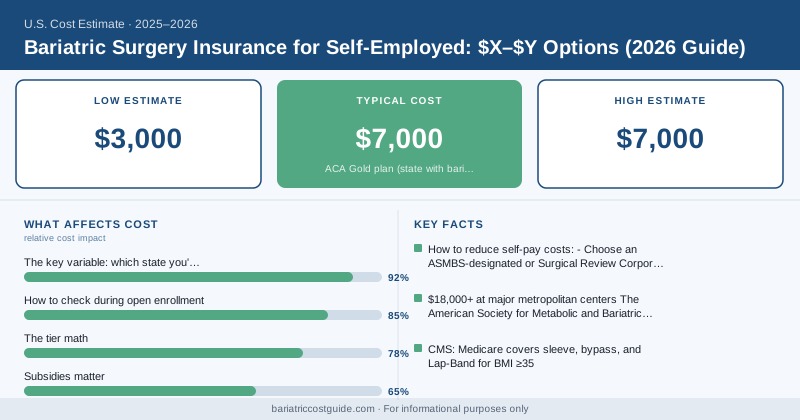
Bariatric Surgery Insurance for Self-Employed: $X–$Y Options (2026 Guide)
{ if eq .Lang "zh" }{ else }{ end }Sarah works as a freelance graphic designer. She’s been at BMI 42 for three years. She knows she qualifies for bariatric surgery. The problem: she left her corporate job two years ago, and her current ACA marketplace plan — a Bronze HDHP she picked because it was $200/month cheaper than Silver — doesn’t cover bariatric surgery at all.
She’s not alone. For the roughly 16 million self-employed Americans, navigating health insurance is already complicated. Adding a major elective-adjacent surgery like bariatric into the mix creates a maze of coverage gaps, timing strategies, and tradeoffs that most people don’t fully understand until they’re already in it.
This guide walks through every realistic option for self-employed people trying to get bariatric surgery — with real cost figures for each path.
Cost by Coverage Scenario
| Coverage Path | Expected Out-of-Pocket |
|---|---|
| ACA Gold plan (state with bariatric mandate) | $3,000–$7,000 (deductible + copays) |
| ACA Silver plan (non-mandate state, with coverage) | $4,000–$9,000 |
| COBRA from prior employer (strategic timing) | $5,000–$10,000 + COBRA premiums |
| Self-pay, US Bariatric Center of Excellence | $12,000–$20,000 |
| Medical tourism — Mexico (accredited program) | $4,000–$7,000 all-in |
| Health sharing ministry | Typically not covered |
ACA Marketplace Plans: Your First and Best Option
The ACA marketplace is where most self-employed people buy health insurance, and it’s the most realistic path to getting bariatric surgery covered without an employer.
The key variable: which state you’re in.
About 22 states — including California, Massachusetts, New York, Colorado, and others — require fully-insured plans to cover bariatric surgery as an essential health benefit. In those states, Silver and Gold marketplace plans will almost certainly include bariatric benefits.
In the remaining states, it’s plan-specific. Some marketplace plans include bariatric coverage; many don’t. You have to read the fine print carefully.
How to check during open enrollment:
- Go to healthcare.gov (or your state exchange)
- Filter plans you’re considering
- Download the Summary of Benefits and Coverage (SBC) for each plan
- Search for “bariatric” or “weight loss surgery”
- Call the insurer directly to confirm — don’t rely solely on plan documents
The tier math: Gold plans have higher premiums but lower cost-sharing. If you’re planning bariatric surgery, a Gold plan that costs $150–$250/month more than Bronze will likely save you thousands in cost-sharing. Run the numbers with your expected deductible and out-of-pocket max.
Subsidies matter: As a self-employed person, your income may qualify for premium tax credits that make Gold-tier coverage very affordable. Use the marketplace calculator before assuming you can only afford Bronze.
Self-Employed Premium Deduction
The COBRA Timing Strategy (Use Carefully)
If you recently left an employer or are about to, COBRA can be a strategic tool — but it requires precise timing.
COBRA lets you continue your former employer’s group health plan for up to 18 months (or 36 months in some cases). Former employer plans are more likely to include bariatric surgery coverage than individual marketplace plans, especially if you worked for a mid-to-large employer.
The calculation: COBRA is expensive — typically $500–$700/month for an individual, since you pay both your and your employer’s share. But if your former plan covered bariatric surgery and you can get the surgery done within the COBRA window:
- 18 months of COBRA at $600/month = $10,800 in premiums
- Surgery out-of-pocket (with coverage): $3,000–$7,000
- Total: $13,800–$17,800
- vs. self-pay in the US: $12,000–$20,000
The math only works if your employer’s plan had robust bariatric coverage and you can complete the surgery during the COBRA period. And you must elect COBRA within 60 days of losing employer coverage.
Health Sharing Ministries: Not a Realistic Option for Bariatric
Health sharing ministries (Sedera, Liberty HealthShare, Medi-Share) have grown in popularity among self-employed individuals as lower-cost alternatives to insurance. For bariatric surgery, they’re essentially a dead end.
Most ministries explicitly exclude elective weight loss surgery, and those that technically allow it attach requirements so stringent that few members qualify. Don’t plan a bariatric surgery strategy around a sharing ministry.
Self-Pay in the US: Making It Work Without Coverage
If you can’t get insurance coverage and don’t want to go abroad, self-pay bariatric surgery at a US facility runs $12,000–$20,000 for gastric sleeve and $18,000–$25,000 for gastric bypass at accredited centers.
How to reduce self-pay costs:
- Choose an ASMBS-designated or Surgical Review Corporation-accredited center — quality and pricing are often competitive
- Ask specifically about uninsured/self-pay pricing; many centers have separate rates
- Financing through CareCredit, Prosper Healthcare Lending, or similar programs offers 12–24 months interest-free periods
- Community hospitals and teaching hospitals in lower cost-of-living areas often charge $12,000–$15,000 vs. $18,000+ at major metropolitan centers
The American Society for Metabolic and Bariatric Surgery (ASMBS) reports that approximately 280,000 bariatric procedures are performed annually in the US — finding accredited programs with competitive self-pay rates is feasible with some research.
Medical Tourism: Real Savings, Real Tradeoffs
Mexico is the most common destination for American bariatric medical tourism, with gastric sleeve running $4,000–$7,000 at accredited programs in Tijuana, Monterrey, and Cancun — roughly $8,000–$13,000 less than US self-pay.
What to look for:
- AAAASF (American Association for Accreditation of Ambulatory Surgery Facilities) accredited facilities
- Surgeons with US board certification or training
- Programs that include pre-op testing, surgical fees, hospital stay, and follow-up
- Established US-based patient coordinators
The real risks:
- Complications happen, and managing them is harder at home without your surgical team
- US physicians may be reluctant to manage complications from a surgery done abroad
- You’ll need a US physician for long-term follow-up — establish that relationship before surgery
- Travel to and from surgery adds cost and logistical complexity
For patients without any path to insurance coverage and limited budget, Mexico bariatric programs at accredited facilities are a legitimate option. Go in with eyes open about the tradeoffs.
The HSA Strategy for Self-Employed
If you’re enrolled in a qualifying high-deductible health plan (HDHP), you can contribute to a Health Savings Account (HSA) and use those funds for bariatric surgery — it’s a qualified medical expense.
In 2026, the HSA contribution limit is $4,300 for individuals and $8,550 for families. HSA contributions are pre-tax, grow tax-free, and are withdrawn tax-free for qualified medical expenses. For a self-employed person in the 24% federal bracket, that’s roughly $1,000–$2,000 in annual tax savings on contributions alone.
HSA funds don’t expire. If you contribute consistently over 2–3 years before your surgery, you can accumulate $8,000–$20,000 in pre-tax dollars specifically designated for medical costs — meaningfully offsetting self-pay costs.
This strategy works best in combination: a Gold or Silver ACA plan in a mandate state with bariatric coverage, supplemented by HSA savings for the deductible and out-of-pocket maximum.
{ if eq .Lang "zh" }Disclaimer: BariatricCostGuide provides cost data for educational purposes only. We are not a medical provider, insurance company, or financial advisor. All costs are estimates based on published data and vary by location, facility, surgeon, insurance plan, and individual health factors. Consult a board-certified bariatric surgeon and your insurance carrier for personalized medical and cost advice.