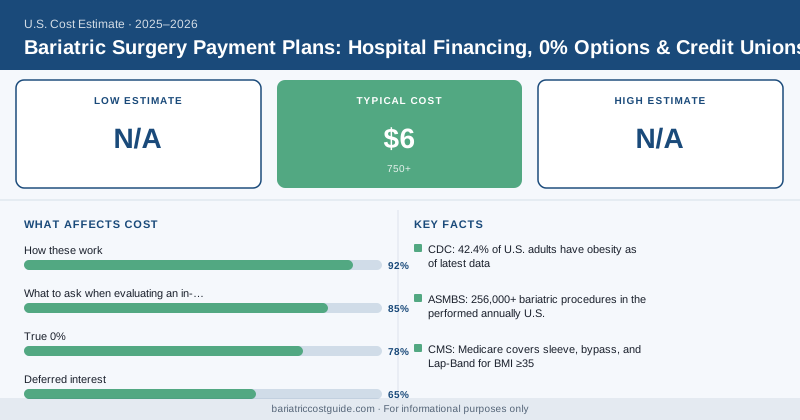
Bariatric Surgery Payment Plans: Hospital Financing, 0% Options & Credit Unions
{ if eq .Lang "zh" }{ else }{ end }Most people don’t have $18,000 sitting in their checking account. The good news: you don’t have to. Bariatric surgery centers know their patients need financing options, and the landscape has improved significantly in the past decade. The bad news: not all payment plans are created equal, and some that sound identical (both call themselves “0% financing”) work completely differently.
Types of Bariatric Surgery Payment Plans
1. In-House Hospital or Surgery Center Payment Plans
Many hospital-based bariatric programs offer their own payment plans — not through a third-party lender, but directly through the health system’s billing department.
How these work:
- You agree to a monthly payment amount before surgery
- The hospital (or surgery center) holds the balance
- If it’s true 0% interest, no interest accrues — your $15,000 balance divided by 12 months = $1,250/month, period
- Some programs charge a small administrative fee instead of interest
What to ask when evaluating an in-house plan:
- Is this true 0% interest or deferred interest?
- What happens if I miss a payment?
- Is there a fee for early payoff?
- Does the plan require a credit check?
- What’s the maximum term length available?
Ask the Right Question
2. Third-Party Medical Financing (CareCredit, Alphaeon, etc.)
These are healthcare-specific credit products offered at the point of care. Most use deferred interest — see our full CareCredit guide for the risk analysis.
Key distinction: deferred interest vs. true 0%:
- True 0%: Interest never accrues. Balance is exactly what you borrowed divided by the months.
- Deferred interest: Interest accrues the whole time but is “forgiven” only if you pay in full before the deadline. Miss by $1 and you owe all of it retroactively.
3. Personal Bank Loans
Traditional banks — your checking account bank, community banks — offer personal loans for medical expenses. These are true interest loans with fixed monthly payments.
Typical rates at traditional banks:
- Excellent credit (750+): 7–10% APR
- Good credit (700–749): 10–15% APR
- Fair credit (650–699): 15–24% APR
- Below 650: Limited options; cosigner may help
4. Credit Union Personal Loans
Credit unions consistently offer personal loan rates 2–5 percentage points lower than commercial banks for equivalent credit profiles, according to NCUA (National Credit Union Administration) data.
| Credit Score Range | Avg. Bank Personal Loan APR | Avg. Credit Union Personal Loan APR |
|---|---|---|
| 750+ | ~8–10% | ~6–8% |
| 700–749 | ~12–16% | ~9–13% |
| 650–699 | ~18–24% | ~14–19% |
| Under 650 | ~24–36% | ~18–27% |
Credit union membership is required, but it’s often easy to qualify — many credit unions serve geographic areas, employer groups, or have open membership with a small donation to a partnering nonprofit. PenFed, Alliant, SECU, Navy Federal (for military), and local credit unions are all worth checking.
0% Financing Options for Bariatric Surgery: Where to Find Them
Hospital financial assistance programs: Many nonprofit hospitals have charity care and financial assistance programs that provide reduced-cost or no-interest payment arrangements for patients who don’t qualify for charity care but can’t pay upfront. Ask the bariatric program’s financial coordinator specifically about “hospital assistance programs” or “self-pay discount and payment arrangements.”
Bariatric program promotions: Some bariatric surgery centers run promotional 0% financing during slow periods (often January–March) to drive volume. These are usually true 0% plans, not deferred interest.
HSA/FSA + payment plan combination: This isn’t technically a “payment plan” but it’s effective. Use your HSA/FSA to pay your deductible and coinsurance (if insured) or a portion of self-pay costs, then use a payment plan for the remainder. This reduces the total financed amount.
Self-Pay Discount + Payment Plan
If you’re paying out of pocket, always ask for the self-pay discount first — before discussing a payment plan. Most bariatric surgery centers offer 20–40% discounts for patients who self-pay (no insurance billing involved). Get the discounted cash price, then apply for a payment plan on that lower number.
Example: A $22,000 gastric bypass offered at a 30% self-pay discount = $15,400. Finance $15,400 instead of $22,000. That difference is $6,600 in principal — far more impactful than a few percentage points of interest rate.
| Financing Scenario | Principal | Term | Monthly Payment | Total Paid |
|---|---|---|---|---|
| $15,400 at true 0% / 12 months | $15,400 | 12 mo | $1,283 | $15,400 |
| $15,400 at 8% / 60 months | $15,400 | 60 mo | $313 | $18,780 |
| $15,400 at 12% / 60 months | $15,400 | 60 mo | $342 | $20,520 |
| $15,400 at 29.99% (CareCredit, missed deadline) | $15,400 | revolving | varies | Potentially $25,000+ |
Medical Billing Advocates
If you’re navigating self-pay bariatric surgery, a medical billing advocate can often negotiate lower prices than you could achieve on your own. They work on contingency (typically 25–35% of savings) or flat fees. For a $20,000 procedure, even a 20% reduction saves $4,000 — worth exploring before committing to a payment plan on the full price.
Comparing Payment Plans: What to Evaluate
Before signing any financing agreement:
- True APR — Not just the promotional rate, but the rate that applies if you miss the payoff
- Origination fees — Some lenders charge 1–8% upfront; this affects the true cost
- Prepayment penalties — Can you pay early without penalty?
- Late payment consequences — Does a late payment kill the promotional rate?
- Monthly payment amount — Can you realistically sustain this for the full term?
- Total cost of financing — Calculate total interest paid over the loan term
Payment plans are a legitimate path to bariatric surgery. The key is understanding exactly what you’re agreeing to before you sign — not discovering the terms six months later when a payment is late.
{ if eq .Lang "zh" }Disclaimer: BariatricCostGuide provides cost data for educational purposes only. We are not a medical provider, insurance company, or financial advisor. All costs are estimates based on published data and vary by location, facility, surgeon, insurance plan, and individual health factors. Consult a board-certified bariatric surgeon and your insurance carrier for personalized medical and cost advice.