Outpatient vs. Inpatient Bariatric Surgery Cost: ASC vs. Hospital in 2025–2026
{ if eq .Lang "zh" }{ else }{ end }In 2012, virtually every gastric sleeve and bypass was done in a hospital with a 2–3 night stay. In 2025, significant numbers of uncomplicated sleeves are performed at ambulatory surgery centers (ASCs) with same-day or 23-hour discharge — at roughly half the cost.
That shift has raised two questions: Is it safe? And how much cheaper is it really?
Cost Comparison: ASC vs. Hospital
| Procedure | Hospital-Based (Inpatient) | Ambulatory Surgery Center (Outpatient) | Savings |
|---|---|---|---|
| Gastric sleeve | $14,000 – $25,000 | $8,000 – $14,000 | $5,000 – $12,000 |
| Gastric bypass | $20,000 – $35,000 | $12,000 – $18,000 | $8,000 – $17,000 |
| Lap-band | $10,000 – $18,000 | $7,000 – $12,000 | $3,000 – $6,000 |
| Gastric balloon | N/A (endoscopic) | $6,000 – $12,000 | — |
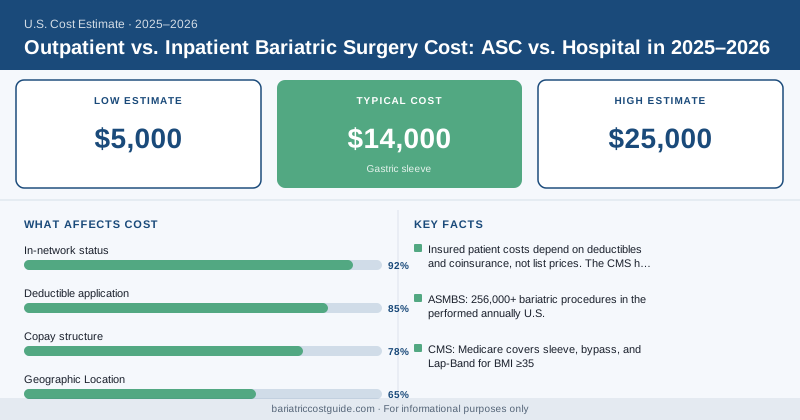
These are self-pay total package estimates. Insured patient costs depend on deductibles and coinsurance, not list prices.
The CMS has noted that ambulatory surgery centers charge Medicare approximately 60% of what hospital outpatient departments charge for equivalent procedures. For self-pay patients, that gap is often similar — or even larger, since hospitals maintain higher list prices.
The Safety Question: Is Outpatient Bariatric Surgery Safe?
This is the question most patients ask first, and the answer is nuanced: for carefully selected patients at MBSAQIP-accredited centers, outpatient bariatric surgery has comparable safety outcomes to inpatient surgery.
A landmark 2020 study in JAMA Surgery analyzing 137,000 bariatric procedures found that 30-day complication rates and readmission rates for sleeve gastrectomy at accredited ASCs were not significantly different from hospital-based procedures for appropriately selected patients.
The operative phrase is “appropriately selected.” Not every bariatric patient is a candidate for outpatient surgery. ASC bariatric surgery is generally appropriate for:
| Factor | Appropriate for ASC | Better Suited for Hospital |
|---|---|---|
| BMI | < 50 (ideally < 45) | 50+ or very severe obesity |
| OSA | Controlled on CPAP | Severe, uncontrolled OSA |
| Cardiac status | No significant cardiac disease | Cardiac comorbidities requiring monitoring |
| Procedure | Sleeve gastrectomy | Gastric bypass, duodenal switch, revision |
| Prior abdominal surgery | Minor or none | Complex prior abdominal surgery |
| Social support | Responsible adult companion | Marginal support situation |
What Inpatient Hospitalization Actually Provides
The overnight hospital stay is primarily for monitoring, pain management, and ensuring you can tolerate oral intake before discharge. The clinical benefits of the 1–2 night inpatient stay include:
- IV fluid management during the period when oral intake is limited
- IV pain and nausea management (easier to titrate than oral medications)
- Nursing monitoring for early signs of complication (vital sign trends, drainage, oxygen saturation)
- Immediate access to imaging, laboratory testing, and surgical consultation if a concern arises
- Physical therapy for early mobilization
For complex patients — high BMI, multiple comorbidities, bypass procedures — that monitoring capability is genuinely valuable. For a healthy 42-year-old with BMI 38 undergoing a first-time sleeve with well-controlled comorbidities, the incremental benefit of 2 nights of nursing monitoring over 23-hour observation may be more limited.
The 23-Hour Observation Model
Many ASC bariatric programs use a 23-hour observation protocol — not quite outpatient (same-day discharge) and not quite inpatient admission. Patients stay overnight but are discharged the following morning if meeting criteria. This model:
- Allows one night of professional monitoring
- Avoids the higher facility costs of formal hospital admission
- Requires the patient to go home with a responsible adult who can monitor for 24–48 hours
From a billing standpoint, 23-hour observation is typically billed as outpatient, which means lower facility fees than inpatient admission — but the recovery monitoring is similar.
Insurance Coverage: Does Setting Matter?
For insured patients, the setting affects your out-of-pocket costs because:
- In-network status: Many hospital-affiliated ASCs are in-network with the same plans as the parent hospital. Free-standing ASCs may have different network status.
- Deductible application: Both inpatient and outpatient costs apply toward your annual deductible and out-of-pocket maximum.
- Copay structure: Some plans have different copay/coinsurance rates for ASC vs. hospital outpatient vs. inpatient settings.
Call your insurance and ask specifically: “If my surgeon performs my bariatric procedure at [facility name], what is my cost-sharing for outpatient surgery vs. inpatient admission?” The dollar difference may be significant enough to inform your setting choice.
Questions to Ask When Comparing ASC vs. Hospital for Your Surgery
- Is the ASC MBSAQIP-accredited? (If not, reconsider strongly — this is non-negotiable for safety)
- What is the surgeon’s complication rate and readmission rate at the ASC specifically?
- What is the closest hospital to the ASC, and what is their transfer protocol if a complication occurs?
- Does the surgeon perform bariatric surgery at a hospital as well, and can I be admitted there if needed?
- What monitoring is provided during the overnight stay at the ASC?
- Is there a physician on-call overnight at the ASC, or just nursing staff?
- What are the criteria for conversion to full hospital admission?
The Bottom Line
Outpatient ASC bariatric surgery costs $8,000–$15,000 for gastric sleeve, versus $14,000–$25,000 for the same procedure in a hospital — a meaningful savings. For carefully selected, lower-risk patients, the safety data is comparable. For higher-BMI patients, complex procedures, or those with significant comorbidities, the inpatient hospital setting provides monitoring that’s worth the premium. The most important factor isn’t setting — it’s MBSAQIP accreditation, surgeon volume, and your candidacy for the lower-acuity environment.
{ if eq .Lang "zh" }Disclaimer: BariatricCostGuide provides cost data for educational purposes only. We are not a medical provider, insurance company, or financial advisor. All costs are estimates based on published data and vary by location, facility, surgeon, insurance plan, and individual health factors. Consult a board-certified bariatric surgeon and your insurance carrier for personalized medical and cost advice.