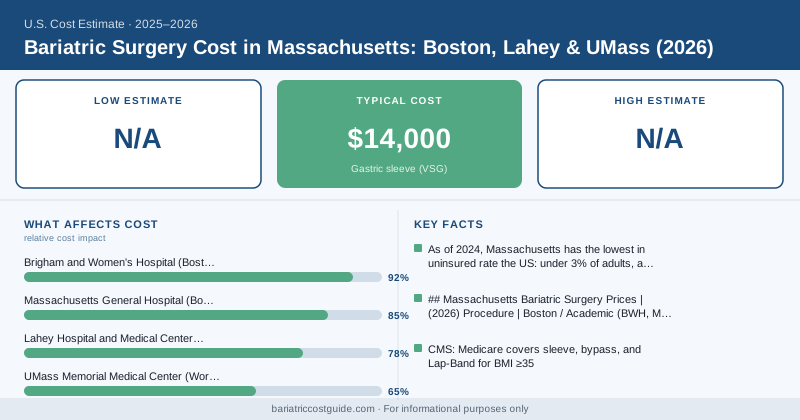
Bariatric Surgery Cost in Massachusetts: Boston, Lahey & UMass (2026)
{ if eq .Lang "zh" }{ else }{ end }Massachusetts has near-universal health insurance coverage — the state’s 2006 healthcare reform law (Chapter 58) was the template for the ACA. As of 2024, Massachusetts has the lowest uninsured rate in the US: under 3% of adults, according to the US Census Bureau. For bariatric patients, that context matters enormously. Most Massachusetts residents have insurance. The question isn’t whether you’re covered — it’s whether your specific plan covers weight loss surgery.
That said, Massachusetts is expensive. Self-pay gastric sleeve at Brigham and Women’s Hospital starts around $22,000 and runs to $34,000 for complex cases. Lahey Hospital in Burlington is somewhat more competitive. For the truly uninsured minority, Massachusetts is not a bargain market — but between MassHealth Medicaid and the state’s commercial insurance mandate, most patients have a legitimate path to covered surgery.
Massachusetts Bariatric Surgery Prices (2026)
| Procedure | Boston / Academic (BWH, MGH) | Lahey / Community | UMass / Worcester | National Average |
|---|---|---|---|---|
| Gastric sleeve (VSG) | $22,000 – $34,000 | $18,000 – $27,000 | $17,500 – $26,500 | $14,000 – $23,000 |
| Gastric bypass (Roux-en-Y) | $26,000 – $38,000 | $21,000 – $30,000 | $20,500 – $29,500 | $18,000 – $28,000 |
| Duodenal switch | $34,000 – $48,000 | $27,000 – $39,000 | $26,000 – $38,000 | $22,000 – $35,000 |
| Mini gastric bypass | $24,000 – $32,000 | $19,500 – $28,000 | $19,000 – $27,500 | $17,000 – $25,000 |
| Revision surgery | $30,000 – $48,000 | $25,000 – $40,000 | $24,000 – $38,000 | $20,000 – $35,000 |
Boston’s academic medical centers charge a premium that reflects their research infrastructure, resident training costs, and reputation. For routine sleeve or bypass surgery in a healthy candidate, Lahey or UMass delivers equivalent outcomes at materially lower cost. The academic premium is worth paying for complex revisional cases, rare metabolic conditions, or when the research trial access matters.
Major Bariatric Programs in Massachusetts
Brigham and Women’s Hospital (Boston) BWH’s Center for Metabolic and Bariatric Surgery is one of the most academically productive bariatric programs in the US. Its research output on long-term metabolic outcomes following Roux-en-Y bypass has been cited hundreds of times in the literature. Practical implication: BWH surgeons are among the most experienced in the country at complex metabolic cases. Self-pay sleeve runs approximately $24,000–$32,000. For patients with complex type 2 diabetes, severe cardiovascular disease, or revisional needs, BWH is a top-tier choice nationally. For routine sleeve in a healthy 40-year-old? Overkill.
Massachusetts General Hospital (Boston) MGH’s Weight Center offers a full bariatric surgery program integrated with its endocrinology, cardiology, and gastroenterology departments. MGH is particularly strong for patients with complex endocrine conditions — PCOS, hypothyroidism, poorly controlled type 2 diabetes. Self-pay sleeve pricing runs $22,000–$34,000. Like BWH, MGH is best matched to patients whose medical complexity justifies the academic premium.
Lahey Hospital and Medical Center (Burlington) Lahey is the best value for bariatric surgery in the greater Boston market for most patients. Its Bariatric and Metabolic Surgery Program in Burlington is MBSAQIP-accredited, high-volume, and priced meaningfully below its Boston academic competitors: self-pay sleeve runs $18,000–$26,000. Lahey is in-network with most major Massachusetts commercial plans — BCBS MA, Tufts Health, Aetna, and Harvard Pilgrim. For straightforward cases, Lahey’s combination of accreditation, volume, and price makes it the rational default choice in eastern Massachusetts.
UMass Memorial Medical Center (Worcester) UMass Memorial’s bariatric program is the major academic option in central Massachusetts. The program is affiliated with UMass Chan Medical School and handles the full range of primary and revisional bariatric procedures. Self-pay pricing at UMass runs $17,500–$26,000 for sleeve — among the most competitive in the state for an academic program. UMass is an excellent choice for patients in the Worcester area and western Massachusetts who want to avoid the Boston premium.
South Shore Health / Tufts Medical (South of Boston) For patients south of Boston — Plymouth County, Quincy, Brockton area — South Shore Health’s bariatric program and Tufts Medical Center in downtown Boston offer additional options. Tufts Medical runs similar pricing to BWH and MGH; South Shore is more competitive at $18,000–$25,000 for sleeve.
MassHealth (Massachusetts Medicaid) Coverage
MassHealth — Massachusetts’s Medicaid and CHIP program — covers bariatric surgery for qualifying adult members. Massachusetts has long been a Medicaid expansion state (its own expansion predated the ACA). MassHealth covers bariatric surgery under standard clinical criteria:
- BMI ≥ 40, or
- BMI ≥ 35 with at least one qualifying comorbidity (type 2 diabetes, hypertension, severe obstructive sleep apnea, coronary artery disease, hyperlipidemia)
- Participation in medically supervised weight management (typically 3–6 months)
- Psychological evaluation and clearance
- Nutritional counseling
- Primary care medical clearance
- Pre-authorization from MassHealth
MassHealth operates through both managed care plans (primarily BMC HealthNet Plan, Health New England, and WellSense) and a fee-for-service program. Coverage criteria and network details vary by plan type. BWH, MGH, Lahey, and UMass Memorial all accept MassHealth for qualified bariatric patients.
Massachusetts State Insurance Mandate
The Insurance Navigation Reality in Massachusetts
Massachusetts’s near-universal coverage creates a different problem than most states: patients assume they’re covered, don’t do the homework, and get surprised by pre-authorization requirements or prior weight loss documentation gaps.
Common pitfalls Massachusetts patients encounter:
Six-month supervised diet requirement — Most Massachusetts commercial plans and MassHealth require documented participation in a physician-supervised weight management program for 3–6 consecutive months before approving surgery. “I tried dieting on my own” doesn’t count. It has to be documented by a physician or certified weight management program. This is the single most common reason for initial denial in Massachusetts.
BMI fluctuation disqualification — Some plans require your qualifying BMI to be maintained across the documentation period. Patients who lose significant weight during the supervised diet period (good news medically, bad news for insurance) sometimes fall below the BMI threshold. Discuss timing strategy with your bariatric team.
Self-insured employer plan variation — Even with the state mandate, large employer ERISA plans can — and do — exclude bariatric coverage. Check your Summary Plan Description before assuming coverage.
Self-Pay Strategies for Massachusetts Patients
For the small percentage of Massachusetts residents who are uninsured or have non-covering ERISA employer plans:
Lahey or UMass are your best in-state options. Both are significantly cheaper than Boston academic centers, both are fully accredited, and both offer competitive outcomes for routine cases.
Rhode Island is 45 minutes away. Lifespan Health (Rhode Island Hospital and Miriam Hospital) in Providence offers MBSAQIP-accredited bariatric surgery at pricing roughly comparable to Lahey — sometimes lower for self-pay. Worth getting a quote.
Connecticut is 2 hours away. Hartford HealthCare and Yale New Haven Health both offer bariatric surgery at pricing below Boston academic hospitals.
For more on financing, see bariatric surgery financing options. For the national insurance landscape, see bariatric surgery insurance coverage.
{ if eq .Lang "zh" }Disclaimer: BariatricCostGuide provides cost data for educational purposes only. We are not a medical provider, insurance company, or financial advisor. All costs are estimates based on published data and vary by location, facility, surgeon, insurance plan, and individual health factors. Consult a board-certified bariatric surgeon and your insurance carrier for personalized medical and cost advice.