Bariatric Surgery Imaging Costs: Upper GI Series, CT Scan, and Pre-Op Tests
{ if eq .Lang "zh" }{ else }{ end }Your bariatric program sends you a pre-op testing checklist. Lab work, cardiology clearance, sleep study, pulmonary function test — and somewhere on the list: upper GI series. Or abdominal CT. Or both.
These imaging tests add $500–$3,000 to your pre-op costs. Not all programs require all of them. Here’s what each test is for, what it costs, and which ones you actually need.
Pre-Op Bariatric Imaging: Complete Cost Breakdown
| Imaging Test | Self-Pay Cost | Insurance Out-of-Pocket | Purpose |
|---|---|---|---|
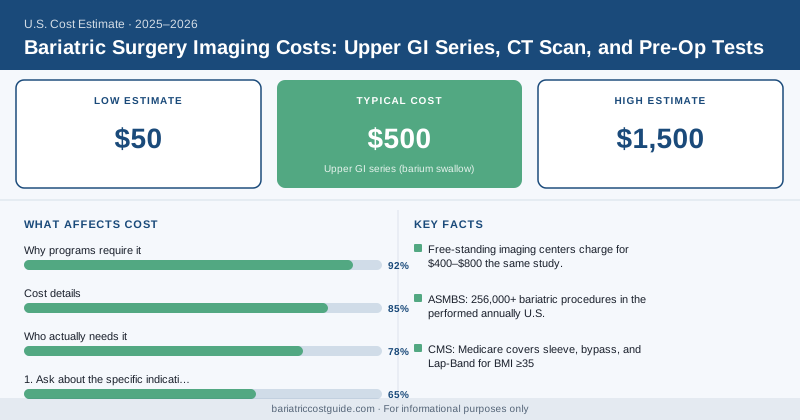
| Upper GI series (barium swallow) | $500 – $1,500 | $50 – $400 | Stomach anatomy, GERD, hiatal hernia |
| Abdominal CT scan | $400 – $1,800 | $100 – $600 | Liver size, anatomy assessment |
| Abdominal ultrasound | $200 – $800 | $50 – $250 | Gallbladder, liver evaluation |
| Chest X-ray | $150 – $500 | $20 – $150 | Pre-anesthesia cardiac/pulmonary baseline |
| Echocardiogram | $1,000 – $3,000 | $200 – $800 | Cardiac function (high-risk patients) |
Not every patient needs every test. The testing requirements vary significantly by program, surgical procedure planned, and individual patient risk factors.
Upper GI Series: The Most Common Pre-Op Imaging
The upper GI series (also called barium swallow or UGI series) involves drinking contrast dye and taking a series of X-rays as it moves through the esophagus, stomach, and upper small intestine.
Why programs require it:
- Detects hiatal hernia (present in 30–40% of bariatric patients, often asymptomatic)
- Evaluates gastroesophageal anatomy for surgical planning
- Identifies prior surgical anatomy in revision candidates
- Some programs use it to assess stomach size and configuration pre-sleeve
Cost details: Hospital radiology departments typically charge $800–$1,500. Free-standing imaging centers charge $400–$800 for the same study. For insured patients, cost sharing depends on your plan’s radiology benefit — deductible, coinsurance, or copay applies.
Who actually needs it: Not all programs require UGI for first-time sleeve or bypass patients with no prior abdominal surgery. For revision procedures (particularly band removal or sleeve-to-bypass conversion), upper GI is more commonly mandatory because prior anatomy must be mapped before reoperation.
Abdominal CT Scan: Liver and Anatomy Assessment
CT scans of the abdomen provide detailed cross-sectional imaging of the liver, spleen, gallbladder, and surrounding structures.
Why programs require it:
- Liver volume and steatosis assessment (fatty liver enlargement affects surgical approach)
- Pre-operative anatomical mapping for complex patients
- Evaluation for incidental findings (gallstones, adrenal abnormalities) that could complicate surgery
Cost details: Hospital CT scans average $800–$2,000 without insurance. Free-standing imaging centers: $400–$800. With insurance, your specific radiology benefit applies.
Who actually needs it: CT is not universally required for standard first-time bariatric procedures. It’s more commonly ordered for patients with known or suspected liver disease, prior abdominal surgery, or unusual anatomy. If your program routinely orders abdominal CT for all patients, it’s worth asking whether this is specifically indicated for your case or is a blanket protocol.
Reducing Imaging Costs: Four Strategies
1. Ask about the specific indication. Not every imaging test on a standard pre-op checklist is equally mandatory for every patient. Ask your bariatric surgeon which tests are required for your specific procedure and which are optional or preference-based.
2. Use free-standing imaging centers. Hospital outpatient radiology charges 2–4x more than independent imaging centers for identical studies. Get a referral to the imaging center rather than the hospital’s radiology department if you’re self-pay.
3. Ask if pre-op testing is bundled into the surgical package. Some all-inclusive bariatric surgery programs include standard pre-op imaging in the package price. Verify before paying separately.
4. Prior imaging may qualify. If you’ve had abdominal imaging (CT or ultrasound) within 6–12 months, ask your surgeon whether recent results can substitute for repeat imaging. Not always possible, but sometimes accepted.
Gallbladder Evaluation
Obesity significantly increases gallstone risk, and rapid weight loss after bariatric surgery is a known gallstone trigger. A 2021 meta-analysis found 30–35% of bariatric patients develop gallstones in the first year post-op without preventive treatment.
For this reason, many programs evaluate the gallbladder before surgery:
- Abdominal ultrasound: Most common gallbladder screening method. Costs $200–$800 self-pay. Widely covered by insurance.
- Concurrent cholecystectomy: If gallstones are found pre-operatively, your surgeon may recommend removing the gallbladder at the same time as bariatric surgery. This adds $1,500–$4,000 to the surgical cost but saves a second surgery later.
Some programs prescribe ursodeoxycholic acid (Actigall/Ursodiol) for 6 months post-op to reduce gallstone formation instead of prophylactic cholecystectomy. Cost: $30–$100/month, typically covered by insurance.
Cardiac Imaging: For Higher-Risk Patients
Echocardiograms and stress tests are required for patients with known or suspected cardiac disease, significant hypertension, or abnormal EKG findings. They’re not standard for healthy bariatric patients under 50.
If your pre-op workup includes a cardiology consultation and echocardiogram that weren’t part of your plan, ask why specifically — the reason should be tied to your individual cardiac risk factors, not routine protocol for all patients.
What Insurance Covers
Pre-operative imaging ordered as part of a medically necessary bariatric surgery evaluation is generally covered by insurance under your plan’s radiology/diagnostic imaging benefit. The key is the ordering physician documenting medical necessity on the order.
For patients whose insurance covers bariatric surgery, pre-op imaging ordered by the bariatric program is typically processed as standard diagnostic imaging — deductible and coinsurance apply. If you’ve met your annual deductible before imaging, coverage may be near-complete.
Bottom Line
Pre-op bariatric imaging adds $500–$3,300 to your preparation costs depending on which tests are required. Upper GI series ($500–$1,500) and abdominal CT ($400–$1,800) are the most expensive and most commonly required. Gallbladder ultrasound ($200–$800) is standard for most programs. Using free-standing imaging centers over hospital radiology can cut self-pay costs by 50–60%. Not every imaging test on a standard checklist is equally necessary for every patient — ask your surgeon which studies are specifically indicated for your procedure and anatomy.
{ if eq .Lang "zh" }Disclaimer: BariatricCostGuide provides cost data for educational purposes only. We are not a medical provider, insurance company, or financial advisor. All costs are estimates based on published data and vary by location, facility, surgeon, insurance plan, and individual health factors. Consult a board-certified bariatric surgeon and your insurance carrier for personalized medical and cost advice.