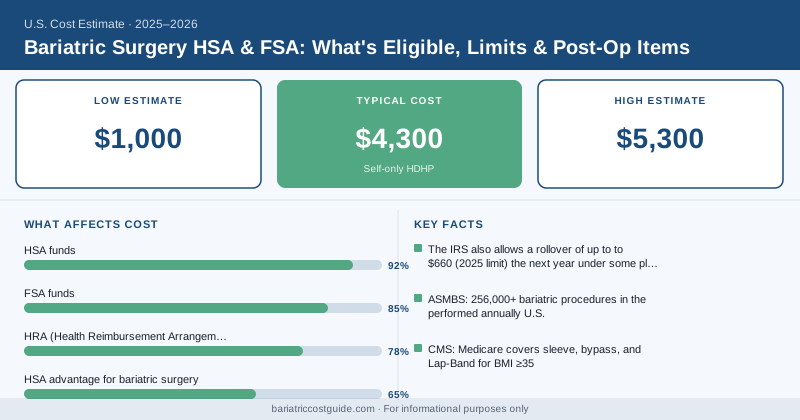
Bariatric Surgery HSA & FSA: What's Eligible, Limits & Post-Op Items
{ if eq .Lang "zh" }{ else }{ end }Paying $18,000 for bariatric surgery and then also paying taxes on the income you used to cover it is an avoidable double hit. If you have a Health Savings Account (HSA) or Flexible Spending Account (FSA), you can pay for bariatric surgery — and a long list of related expenses — with pre-tax dollars, effectively reducing the real cost by 22–37% depending on your tax bracket. Here’s how it works.
Bariatric Surgery Is an IRS-Qualified Medical Expense
The IRS classifies surgery for obesity as a qualified medical expense under IRC Section 213(d). This means:
- HSA funds can pay for bariatric surgery tax-free
- FSA funds can pay for bariatric surgery tax-free
- HRA (Health Reimbursement Arrangement) may also cover it, based on employer plan design
This covers the surgery itself, hospital charges, surgeon fees, anesthesia, pre-op diagnostic tests, and required pre-op consultations (nutrition, psychology, etc.).
2025 HSA Contribution Limits
| Coverage Type | 2025 HSA Limit | 55+ Catch-Up |
|---|---|---|
| Self-only HDHP | $4,300 | +$1,000 = $5,300 |
| Family HDHP | $8,550 | +$1,000 = $9,550 |
To contribute to an HSA, you must be enrolled in a High Deductible Health Plan (HDHP) and not have other disqualifying coverage. In 2025, the minimum HDHP deductible is $1,650 for self-only coverage and $3,300 for family coverage.
HSA advantage for bariatric surgery: HSA contributions carry over indefinitely. You can build up an HSA balance over several years specifically to fund bariatric surgery. Unlike FSAs, there’s no “use it or lose it” pressure.
2025 FSA Contribution Limits
| FSA Type | 2025 Contribution Limit |
|---|---|
| Healthcare FSA | $3,300 per employee |
| Dependent care FSA | $5,000 per household |
| Limited-purpose FSA (dental/vision only) | $3,300 |
FSA limitation: Healthcare FSAs have a “use it or lose it” rule. You must use the funds by the end of your plan year (or during a grace period of up to 2.5 months that some plans offer). The IRS also allows a rollover of up to $660 (2025 limit) to the next year under some plan designs.
FSA advantage for bariatric surgery: With an FSA, you can elect your full annual contribution at the start of the year and access the entire amount immediately. If your surgery is in January and you contributed $3,300 for the year, all $3,300 is available even though you’ve only made one month of contributions. This front-loading feature is a significant advantage for large planned expenses.
The Tax Savings Math
Pre-tax payments mean you avoid income tax (federal + state) and FICA taxes on contributions. Let’s look at what that means for someone in the 22% federal bracket:
| Expense Paid via HSA/FSA | Pre-Tax Savings (22% bracket) | Pre-Tax Savings (32% bracket) |
|---|---|---|
| $3,300 (one year FSA) | ~$726 | ~$1,056 |
| $5,300 (HSA self-only + catch-up) | ~$1,166 | ~$1,696 |
| $9,550 (HSA family + catch-up) | ~$2,101 | ~$3,056 |
If you can stack multiple years of HSA contributions before surgery, your savings compound. Two years of family HSA contributions at maximum = $17,100 available for bariatric costs, with roughly $3,762 saved in taxes (22% bracket).
Post-Op Expenses That Qualify for HSA/FSA
This is where HSA/FSA value extends well beyond the surgery itself. Many post-bariatric surgery expenses are qualified medical expenses:
| Post-Op Expense | HSA/FSA Eligible? |
|---|---|
| Bariatric vitamins (surgeon-prescribed) | Yes — with prescription or letter of medical necessity |
| Protein supplements (prescribed) | Yes — with medical documentation |
| Follow-up office visits | Yes |
| Blood work and lab tests | Yes |
| Nutritional counseling | Yes |
| Mental health counseling (post-op) | Yes |
| Prescription medications | Yes |
| Medical compression garments | Yes (post-surgical) |
| CPAP supplies (if sleep apnea resolves) | Yes |
| Skin removal surgery (medically necessary) | Yes — requires medical necessity documentation |
| Gym membership | Generally No — not a qualified medical expense |
| Regular vitamins without medical necessity | Generally No |
Get a Letter of Medical Necessity
Paying for Bariatric Surgery When Insurance Doesn’t Cover It
If you’re self-paying for bariatric surgery — either because your insurance doesn’t cover it or while waiting for coverage to kick in — HSA/FSA funds can cover the full surgical cost at qualifying facilities.
Strategy for self-pay bariatric surgery:
- Maximize HSA contributions in the years before surgery
- If using FSA, elect the maximum and schedule surgery early in the plan year to maximize front-loaded availability
- Pay the remainder via medical loan or payment plan — HSA/FSA funds can also be used to pay off medical debt for qualifying expenses
- Save all receipts and EOBs for tax documentation
What You Cannot Pay for with HSA/FSA
- Gym memberships or fitness programs (even when recommended for weight loss)
- Cosmetic procedures not medically necessary
- Weight loss supplements not prescribed
- Meal replacement programs without a prescription or medical direction
- Insurance premiums (with limited exceptions for Medicare and COBRA)
Using HSA/FSA Alongside Insurance
If you have insurance that partially covers bariatric surgery, HSA/FSA funds can cover your:
- Deductible
- Coinsurance (your share after deductible)
- Copayments
- Any out-of-pocket costs insurance doesn’t cover
This is the most efficient use of HSA/FSA funds for covered procedures — you’re turning the portion you’d pay anyway into a pre-tax payment.
The bottom line: if you have access to an HSA or FSA, use it for bariatric surgery expenses. You’re legally leaving money on the table if you don’t — real dollars that effectively reduce your procedure cost just by using an account you may already have.
{ if eq .Lang "zh" }Disclaimer: BariatricCostGuide provides cost data for educational purposes only. We are not a medical provider, insurance company, or financial advisor. All costs are estimates based on published data and vary by location, facility, surgeon, insurance plan, and individual health factors. Consult a board-certified bariatric surgeon and your insurance carrier for personalized medical and cost advice.