Bariatric Surgery Hospital Stay Cost: What the Facility Fee Covers
{ if eq .Lang "zh" }{ else }{ end }Your surgeon quotes you a surgery fee. Then the hospital sends a separate bill — often two to three times larger. That’s the facility fee, and it’s one of the most misunderstood parts of bariatric surgery costs.
Here’s what you’re actually paying for when you stay in a hospital for bariatric surgery, and how the facility fee breaks down.
What the Facility Fee Covers
The facility fee is the hospital’s or ambulatory surgery center’s charge for providing the physical location, staffing, equipment, and overnight care for your procedure. It typically includes:
- Operating room time and equipment (laparoscopic tower, insufflation equipment, staplers)
- Recovery room time
- Nursing care during your inpatient stay
- Meals (usually liquid/clear diet post-op)
- Standard medications administered during your stay (IV fluids, pain management, anti-nausea drugs, blood clot prophylaxis)
- Monitoring equipment and nursing labor
- Any imaging or diagnostics ordered during your admission (not always covered)
What it usually does NOT include: surgeon fee, anesthesiologist fee, pathology fees (if any tissue is sent for analysis), or any services from physicians who are separate billing entities.
Hospital Stay Duration and Cost by Procedure
| Procedure | Typical Stay Duration | Facility Fee Range |
|---|---|---|
| Gastric sleeve | 1 – 2 nights | $5,000 – $12,000 |
| Roux-en-Y gastric bypass | 2 – 3 nights | $8,000 – $18,000 |
| Duodenal switch | 2 – 4 nights | $10,000 – $22,000 |
| Lap-band | 1 night or same-day | $4,000 – $9,000 |
| Gastric balloon | Same-day | $3,000 – $7,000 |
| Revision bariatric surgery | 2 – 4 nights | $10,000 – $25,000 |
Why Facility Fees Vary So Dramatically
The same hospital can charge very different amounts for the same stay depending on whether you have insurance and which insurance you have. Hospital chargemaster rates (the “list price”) are frequently 3–5x what they actually collect from insurance companies, who have negotiated discounted rates.
For insured patients: You pay your deductible plus coinsurance on the allowed amount (the rate your insurer negotiated). Most patients with insurance pay $1,500–$5,000 in out-of-pocket facility costs for a standard sleeve or bypass.
For self-pay patients: Hospitals often have a separate self-pay discount — typically 40–60% off the list price — if you pay cash or set up a payment plan. Always negotiate. The hospital’s billing department can almost always do better than the first number they give you.
Hospital type matters. An academic medical center in a major city charges more than a community hospital. A hospital-owned outpatient surgery center charges less than the main hospital campus. A free-standing ambulatory surgery center (not hospital-owned) typically charges the least.
| Facility Type | Relative Facility Fee |
|---|---|
| Academic medical center (major city) | Highest ($8,000 – $18,000+) |
| Community hospital | Moderate ($6,000 – $12,000) |
| Hospital-based outpatient ASC | Lower ($5,000 – $10,000) |
| Free-standing accredited ASC | Lowest ($3,000 – $8,000) |
Understanding Your Hospital Bill
When you receive a hospital bill, you may see separate line items for:
- Room and board (per diem): The daily hospital room charge. This can range from $1,500 to $5,000+ per night at major hospitals.
- Operating room charges: Time in the OR, typically billed in 15–30 minute increments. A 90-minute sleeve might generate $4,000–$8,000 in OR charges alone.
- Recovery room: Additional charges for PACU (post-anesthesia care unit) time.
- Pharmaceuticals: Medications dispensed in-house are typically billed separately and often at significant markup from retail prices.
- Supplies: Disposable surgical supplies — staplers, trocars, and laparoscopic instruments — add $1,000–$3,000 to the bill.
How to Negotiate Your Hospital Facility Bill
Hospital bills for bariatric surgery are frequently negotiable, especially for self-pay patients. Here’s how to approach it:
- Request an itemized bill: Every patient has the right to see exactly what they were charged. Review it for errors — duplicate charges and billed-but-not-provided services are common.
- Ask for the self-pay discount: Most hospitals have a policy that reduces bills 40–60% for uninsured patients who pay promptly.
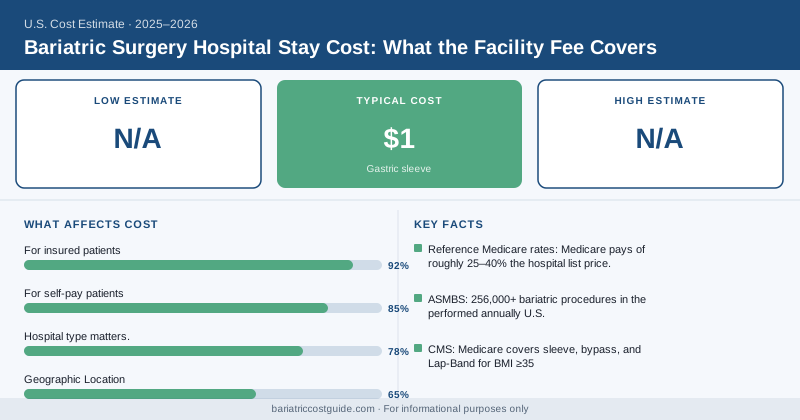
- Reference Medicare rates: Medicare pays roughly 25–40% of the hospital list price. Use this as your opening negotiation anchor.
- Ask about financial assistance: Hospitals with nonprofit status must offer charity care programs. If your income is under 300–400% of the federal poverty level, you may qualify for significant reduction.
- Get a payment plan: Most hospitals prefer a monthly payment plan over sending a balance to collections. A $12,000 bill can often become $200–$300/month with 0% interest.
When Extended Hospital Stays Happen
Most uncomplicated bariatric procedures discharge within 1–2 days. Extended stays — 3+ days — occur with:
- Complications (leak, bleeding, pulmonary embolism) — see our article on complication costs
- High BMI patients with more complex post-op monitoring needs
- Medical comorbidities requiring ongoing management post-op
- Pain or nausea management challenges delaying oral intake
Each additional hospital day adds $2,000–$5,000 to your bill. Complication-driven extended stays can push total facility fees into the $30,000–$80,000+ range.
The Bottom Line
The hospital facility fee for a standard bariatric procedure runs $5,000–$18,000 depending on procedure type, facility, and length of stay. It’s typically the largest single component of your total bariatric surgery bill. With insurance, your out-of-pocket share is usually $1,500–$5,000. Self-pay patients can negotiate meaningful discounts — but should always verify that a lower-cost facility is MBSAQIP-accredited before choosing based on price alone.
{ if eq .Lang "zh" }Disclaimer: BariatricCostGuide provides cost data for educational purposes only. We are not a medical provider, insurance company, or financial advisor. All costs are estimates based on published data and vary by location, facility, surgeon, insurance plan, and individual health factors. Consult a board-certified bariatric surgeon and your insurance carrier for personalized medical and cost advice.