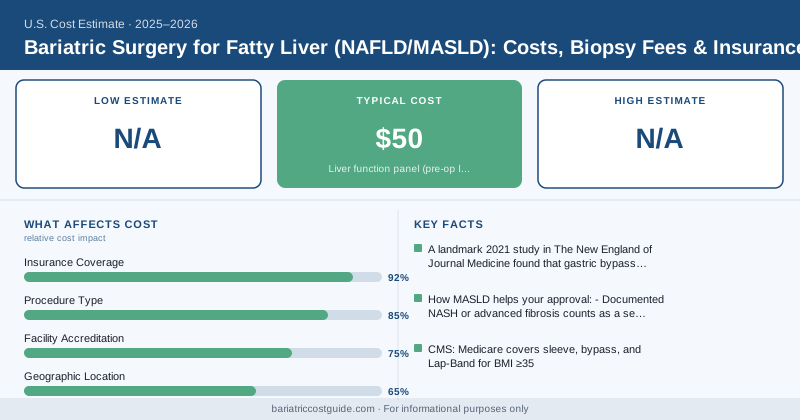
Bariatric Surgery for Fatty Liver (NAFLD/MASLD): Costs, Biopsy Fees & Insurance
{ if eq .Lang "zh" }{ else }{ end }Approximately 90% of morbidly obese patients have nonalcoholic fatty liver disease (NAFLD) — now renamed metabolic dysfunction-associated steatotic liver disease (MASLD). Most don’t know it. A 2023 review in Hepatology estimated that 25% of the global adult population has MASLD, with the highest rates in people with obesity and type 2 diabetes. In surgical candidates with BMI over 40, the proportion approaches 90%.
That’s not just a liver problem — it’s a surgical planning problem. Your fatty liver can complicate the procedure, affect your insurance approval timeline, and add thousands in pre-op costs. Here’s what you need to know.
How MASLD Affects Your Surgery Cost
| MASLD-Related Cost Item | Typical Range |
|---|---|
| Liver function panel (pre-op labs) | $50 – $300 |
| Abdominal ultrasound (liver screening) | $200 – $600 |
| FibroScan (liver stiffness test) | $400 – $1,200 |
| Liver biopsy (if required — outpatient) | $1,500 – $4,000 |
| Hepatology consultation | $300 – $700 |
| Pre-op liver shrinkage diet (food cost) | $300 – $600 over 2–4 weeks |
| Delayed surgery due to NASH workup | $0 – $2,000+ (additional visit costs) |
Not every patient pays all of these. Mild MASLD (simple steatosis) rarely requires more than standard pre-op labs. It’s the patients with advanced fibrosis or suspected NASH who face the full evaluation stack — and the $1,500–$4,000 liver biopsy.
Why Fatty Liver Matters in the Operating Room
A healthy liver sits compactly in the upper abdomen, giving the surgeon a clear view of the stomach. A fatty, enlarged liver does the opposite — it drapes over the stomach, obstructs the operative field, and increases bleeding risk.
Your surgeon can’t simply work around it. An excessively large liver is one of the most common reasons a laparoscopic bariatric procedure gets converted to open surgery mid-operation — a complication that extends your hospital stay, increases your recovery time, and raises your total cost.
The pre-op liver shrinkage diet (typically 2–4 weeks of high-protein, low-carbohydrate eating, sometimes full liquid) addresses this directly. It reduces liver volume by 10–20% and is standard protocol at most accredited bariatric programs. Think of it as medically necessary, not optional.
NASH vs. Simple Steatosis: Why the Distinction Matters
MASLD exists on a spectrum:
- Simple steatosis — fat in liver cells, no significant inflammation. Extremely common, generally manageable.
- NASH (nonalcoholic steatohepatitis) — fat plus inflammation and cell damage. Present in roughly 20–30% of MASLD patients.
- NASH with fibrosis — scarring of liver tissue. Stage F3–F4 fibrosis is cirrhosis.
- Cirrhosis — end-stage liver disease. A potential contraindication for elective bariatric surgery depending on severity.
When Is a Liver Biopsy Required Before Bariatric Surgery?
Most bariatric programs don’t require a biopsy for all patients with MASLD. A biopsy is typically ordered when:
- Liver enzymes (AST, ALT) are persistently elevated (>2x normal)
- FibroScan suggests advanced fibrosis (liver stiffness >9–12 kPa)
- Imaging shows nodular or shrunken liver suggesting cirrhosis
- The surgeon wants to know whether intraoperative liver biopsy is needed at the time of surgery
- Insurance requires documentation of liver disease stage for coverage purposes
An outpatient ultrasound-guided liver biopsy runs $1,500–$4,000 depending on the facility and whether you’re insured. Under insurance, your out-of-pocket is typically $300–$800 if you haven’t met your deductible.
How Bariatric Surgery Reverses MASLD
This is where the story turns positive. Bariatric surgery is currently the most effective treatment for NASH — more effective than any available medication.
A landmark 2021 study in The New England Journal of Medicine found that gastric bypass resolved NASH histologically (confirmed by biopsy) in approximately 84% of patients at 5 years. Even sleeve gastrectomy resolves NASH in 50–70% of patients. The mechanisms include:
- Rapid reduction in liver fat — begins within days of caloric restriction
- Improved insulin sensitivity — reduces the metabolic drive for fat accumulation in the liver
- Weight loss — 25–35% excess weight loss removes the fundamental driver of MASLD
Fibrosis improvement (actual reversal of scarring) takes longer — typically 1–3 years — and is more variable. But it happens. Multiple studies have shown regression of liver fibrosis after bariatric surgery, something that lifestyle intervention alone rarely achieves.
Insurance and MASLD: A Complicated Relationship
Insurance companies treat MASLD as a comorbidity that can strengthen your bariatric surgery case — or complicate it, depending on the severity.
How MASLD helps your approval:
- Documented NASH or advanced fibrosis counts as a serious obesity-related comorbidity, which most insurers require for bariatric coverage
- Hepatologists documenting the severity and the need for treatment add clinical weight to your case
How MASLD can complicate approval:
- Advanced cirrhosis (Child-Pugh B or C) is a contraindication at most programs — some insurers will deny coverage if the surgical risk is deemed excessive
- A required hepatology workup that delays surgery for 3–6 months pushes your out-of-pocket costs up with additional visits and tests
| Insurance Scenario | Likely Out-of-Pocket |
|---|---|
| Mild MASLD, standard pre-op | $50 – $300 additional |
| NASH with required hepatology consult | $400 – $1,200 additional |
| NASH with FibroScan required | $800 – $2,000 additional |
| Advanced fibrosis, biopsy required | $1,500 – $4,500 additional |
| Cirrhosis requiring evaluation; surgery delayed or denied | $2,000 – $5,000+ additional, surgery potentially not covered |
Comparing Bariatric Surgery to Emerging NASH Medications
As of 2025–2026, several NASH/MASH medications are entering the market — including resmetirom (Rezdiffra), the first FDA-approved MASH treatment. Monthly costs for these medications run $1,500–$3,000 and require ongoing use. They address fibrosis but don’t produce substantial weight loss.
GLP-1 medications (semaglutide, tirzepatide) also reduce liver fat significantly as a secondary effect of weight loss, but at $600–$1,500/month with inconsistent insurance coverage.
Bariatric surgery remains the only intervention that simultaneously and durably addresses the obesity driving MASLD, the insulin resistance fueling it, and the NASH pathology itself — with outcomes lasting 10+ years in most patients.
What to Ask Your Bariatric Program
Before committing to a surgery date, ask:
- Do you require a hepatology clearance for elevated AST/ALT?
- What liver enzyme cutoffs trigger additional workup at your program?
- Do you perform intraoperative liver biopsy if NASH is suspected?
- Does a fatty liver diagnosis affect my expected surgery date?
- How do I complete the pre-op liver shrinkage diet, and does my program provide support?
The answers will tell you whether MASLD adds days or months to your timeline — and thousands to your total pre-op cost.
{ if eq .Lang "zh" }Disclaimer: BariatricCostGuide provides cost data for educational purposes only. We are not a medical provider, insurance company, or financial advisor. All costs are estimates based on published data and vary by location, facility, surgeon, insurance plan, and individual health factors. Consult a board-certified bariatric surgeon and your insurance carrier for personalized medical and cost advice.