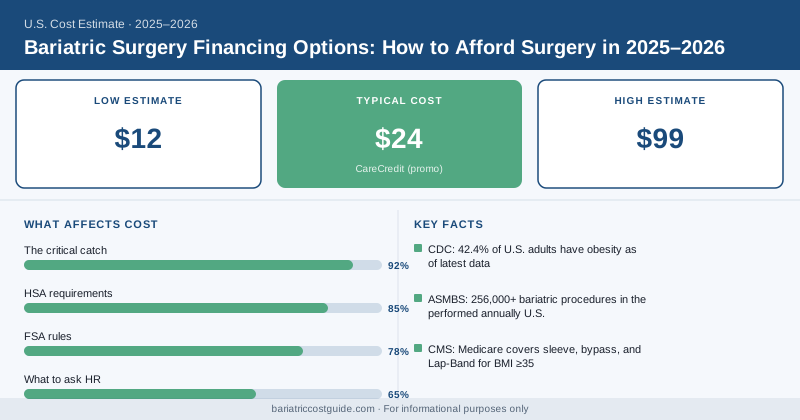
Bariatric Surgery Financing Options: How to Afford Surgery in 2025–2026
{ if eq .Lang "zh" }{ else }{ end }A $15,000 gastric sleeve sounds like an impossible number for most middle-income Americans. Broken into 60 monthly payments at a reasonable interest rate, it’s $280/month — cheaper than many car payments.
Financing doesn’t make surgery free. But it makes it cash-flow manageable, which for many patients is the difference between getting the procedure and spending another decade living with obesity’s health consequences. Here’s every financing option available, with honest assessments of each.
CareCredit: The Most Widely Accepted Medical Credit Card
CareCredit is a dedicated healthcare credit card accepted at most bariatric surgery centers. It offers deferred-interest promotional periods of 6, 12, 18, or 24 months with 0% APR — if you pay the full balance before the promotional period ends.
The critical catch: CareCredit is deferred interest, not 0% interest. If you carry any balance after the promotional period, you’re charged interest retroactively on the entire original balance at 26.99% APR. This is how CareCredit traps unwary borrowers.
Use CareCredit only if:
- You can comfortably pay off the full balance within the promotional period, AND
- You set up automatic payments to ensure you don’t miss the deadline
If you can’t pay it off in 12–24 months, a fixed-rate medical loan with lower APR is a better choice.
| Financing Option | APR Range | Term Options | Best For |
|---|---|---|---|
| CareCredit (promo) | 0% for 12–24 mo, then 26.99% | 12–24 months | Quick payoff, discipline required |
| Prosper Healthcare Lending | 6.99% – 29.99% | 12–84 months | Fixed-rate certainty, longer terms |
| LightStream medical loan | 7.49% – 25.99% | 24–84 months | Good credit, competitive rates |
| Hospital payment plans | 0% (often) | 12–24 months | Ask your specific program |
| Home equity loan | 7%–10% | Up to 15 years | Homeowners; lowest rates |
| HSA/FSA | N/A (pre-tax) | Depends on balance | Best tax advantage available |
Prosper Healthcare Lending: The Better Option for Many Patients
Prosper Healthcare Lending is a medical loan specialist that partners directly with bariatric surgery programs. Unlike CareCredit, Prosper offers true fixed-rate loans — no deferred interest, no rate surprises.
Application is online; decisions are typically same-day. Rates depend on credit score:
- Excellent credit (720+): 6.99%–12%
- Good credit (680–720): 12%–19%
- Fair credit (620–680): 19%–29.99%
Terms up to 84 months mean a $15,000 loan at 15% APR runs about $300/month over 60 months. That’s $18,000 total — an extra $3,000 in interest, but the surgery you need now.
How to Get the Best Loan Rate
Your credit score drives your rate more than anything else. Before applying for medical financing:
- Check your credit report at AnnualCreditReport.com for errors (errors affect 1 in 5 reports)
- Pay down any revolving credit card balances below 30% of limit
- Don’t open new credit accounts in the 3 months before applying
- Apply for multiple medical loans within a 14-day window — credit bureaus treat this as rate shopping, not multiple applications
A 50-point credit score improvement can reduce your interest rate by 5–8 percentage points, saving $1,500–$3,000 on a $15,000 loan.
HSA and FSA: The Best Pre-Tax Financing Tool
Health savings accounts (HSA) and flexible spending accounts (FSA) let you pay for bariatric surgery with pre-tax dollars. If you’re in the 22% federal tax bracket, using $10,000 in HSA funds instead of after-tax dollars saves you $2,200 in taxes — effectively a 22% discount.
HSA requirements: You must have a qualifying high-deductible health plan (HDHP). In 2024, contribution limits are $4,150 (individual) or $8,300 (family). HSA balances roll over indefinitely — no “use it or lose it” rule.
FSA rules: FSAs don’t require HDHPs but do have “use it or lose it” rules (or a $640 rollover). They’re best for funding pre-op workup costs ($1,000–$3,000) rather than the full surgery.
Both types of accounts can pay for: surgeon fees, facility fees, anesthesia, pre-op evaluations, vitamins and supplements post-surgery, and follow-up visits.
Employer Benefits: The Underutilized Option
Many large employers — particularly self-insured employers with wellness programs — offer bariatric surgery benefits or weight loss program benefits that patients don’t know about.
What to ask HR:
- Does our health plan include a bariatric surgery benefit?
- Do we offer any bariatric-specific Centers of Excellence programs?
- Are there any employer-funded wellness programs that could offset bariatric surgery costs?
Some large employers (Amazon, Boeing, Walmart) have partnered with bariatric centers to offer surgery at deeply discounted rates as a benefit, recognizing that treating obesity reduces their long-term healthcare costs.
Check your employer’s benefits guide carefully — this information isn’t always in the obvious places.
Medical Tourism as Cost Reduction
For patients financing surgery, Mexico changes the math dramatically. Financing $6,000 at 15% APR over 48 months is $167/month. Financing $18,000 is $502/month. That’s a $335/month difference — meaningful over 4 years.
If you’re going to finance bariatric surgery anyway, the combination of a reputable Mexican facility + a medical loan makes surgery financially accessible to patients who couldn’t afford U.S. pricing even with financing.
The Bottom Line
Bariatric surgery is financeable even at $15,000–$35,000 self-pay. The best strategy for most patients: use all available HSA/FSA funds (pre-tax savings), apply for a fixed-rate medical loan through Prosper or LightStream (not CareCredit unless you can pay off in 12 months), ask your employer about bariatric benefits, and consider Mexico pricing for serious cost reduction. The monthly payment on a $15,000 loan is often less than what obesity-related medication and healthcare costs the same patient every month.
{ if eq .Lang "zh" }Disclaimer: BariatricCostGuide provides cost data for educational purposes only. We are not a medical provider, insurance company, or financial advisor. All costs are estimates based on published data and vary by location, facility, surgeon, insurance plan, and individual health factors. Consult a board-certified bariatric surgeon and your insurance carrier for personalized medical and cost advice.