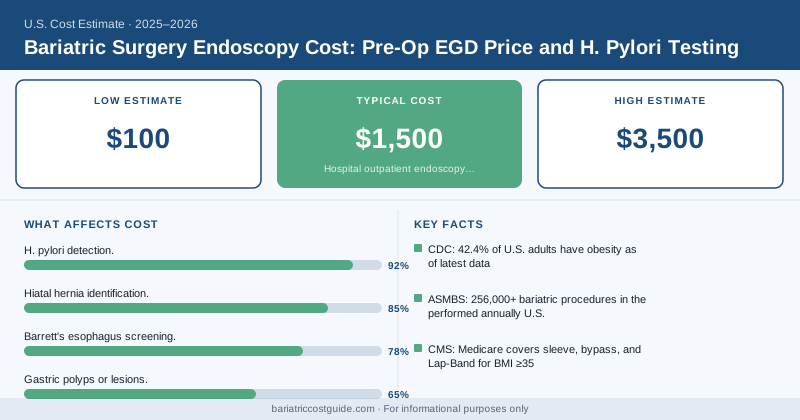
Bariatric Surgery Endoscopy Cost: Pre-Op EGD Price and H. Pylori Testing
{ if eq .Lang "zh" }{ else }{ end }“You need an endoscopy before we can schedule your surgery.” That sentence from the bariatric coordinator surprises a lot of patients — especially those who feel perfectly healthy. No symptoms, no heartburn, no history of GI problems.
You still probably need it. Here’s why — and what it costs.
What EGD Costs for Bariatric Pre-Op
EGD stands for esophagogastroduodenoscopy — a flexible camera scope passed through the mouth to visualize the esophagus, stomach, and upper small intestine (duodenum). It’s an outpatient procedure performed under moderate sedation.
| Setting | Self-Pay Cost | With Insurance (Out-of-Pocket) |
|---|---|---|
| Hospital outpatient endoscopy suite | $1,500 – $3,500 | $100 – $800 |
| Ambulatory surgery center (ASC) | $800 – $2,000 | $75 – $500 |
| Free-standing GI center | $800 – $1,800 | $75 – $400 |
| EGD + H. pylori testing (add-on) | $100 – $400 additional | $20 – $100 additional |
| EGD + biopsy (if indicated) | $200 – $600 additional | $50 – $200 additional |
The cost gap between hospital-based and ambulatory/free-standing settings is substantial. Hospital facility fees are the primary driver — for an identical 15-minute procedure, facility fees alone can triple total cost. If you’re self-pay or on a high-deductible plan, always ask whether the endoscopy can be performed at an ASC or free-standing GI center.
Why Bariatric Programs Require Pre-Op EGD
The clinical rationale for routine pre-op EGD is strong:
H. pylori detection. H. pylori infection is present in approximately 15–30% of US patients and much higher in specific populations. Post-gastric bypass, H. pylori greatly increases the risk of marginal ulcer — an ulcer at the surgical anastomosis. A 2019 meta-analysis in Surgery for Obesity and Related Diseases found H. pylori-positive patients had 4x higher marginal ulcer rates post-bypass than H. pylori-negative patients. Pre-op detection and treatment prevents this complication.
Hiatal hernia identification. Endoscopy directly visualizes the gastroesophageal junction. Large hiatal hernias can be repaired concurrent with sleeve or bypass — but only if identified pre-operatively. EGD is more accurate than upper GI series for hiatal hernia grading.
Barrett’s esophagus screening. Patients with significant GERD may have Barrett’s esophagus (pre-cancerous changes in the esophageal lining) — a finding that affects the choice between sleeve (which worsens GERD) and bypass (which resolves it). Barrett’s identified pre-op changes the surgical recommendation.
Gastric polyps or lesions. Incidental findings on EGD — polyps, ulcers, early mucosal changes — occasionally require biopsy and sometimes change or delay the surgical timeline. Better identified before than after.
H. Pylori Testing: What a Positive Result Means for Your Surgery
If EGD finds H. pylori, your surgeon will prescribe eradication treatment before surgery:
Standard treatment: 10–14 days of “triple therapy” — two antibiotics (usually clarithromycin + amoxicillin) plus a proton pump inhibitor (omeprazole). Cost: $50–$200 depending on insurance coverage.
Confirmation of eradication: A urea breath test ($100–$300) or stool antigen test ($50–$150) is done 4 weeks after treatment to confirm H. pylori is gone before scheduling surgery.
Timeline impact: H. pylori eradication typically adds 6–8 weeks to your pre-op timeline (2 weeks treatment + 4 weeks confirmation wait). Plan for this when coordinating your surgical date.
Why this matters financially: Marginal ulcers post-bypass require endoscopic treatment and prolonged proton pump inhibitor therapy — costs of $500–$3,000+ for management. Preventing them with a $50 antibiotic course is clearly cost-effective.
Which Procedures Always Require Pre-Op EGD
Gastric bypass: Near-universal requirement. H. pylori and hiatal hernia assessment are both procedure-specific concerns that directly affect post-operative complication risk.
Gastric sleeve: Required by most but not all programs. GERD assessment and Barrett’s screening are the primary indications for sleeve patients. Programs increasingly require it after research links sleeve gastrectomy to de novo GERD development.
Duodenal switch: Required. Complex anatomy and anastomotic ulcer risk make pre-op mucosal assessment important.
Revision procedures: Always required. Prior anatomical changes mean endoscopic mapping of current anatomy is essential for surgical planning.
Gastric balloon: EGD is actually the procedure itself — the balloon is placed endoscopically under the same sedation. There’s no separate pre-op EGD.
Insurance Coverage for Pre-Op EGD
Pre-op EGD ordered for bariatric surgery evaluation is typically covered as diagnostic endoscopy under your plan’s GI/gastroenterology benefit. The ordering physician should document the specific clinical indication in the order — “pre-bariatric surgery evaluation” with the patient’s ICD-10 diagnosis codes (obesity, GERD, etc.) supports coverage.
Cost-sharing: after deductible, most plans cover 70–90% of the allowed amount. Choosing an in-network gastroenterologist at an ASC or free-standing center typically minimizes your out-of-pocket versus a hospital-based suite.
One watch-out: if the EGD leads to a biopsy, that’s billed separately from the procedure and may have separate cost-sharing implications.
Total Pre-Op Testing Context
EGD is one component of the full pre-op testing bill that most bariatric patients face. For a full picture of every pre-op cost including lab work, cardiology, sleep study, and psychological evaluation, see our bariatric surgery pre-op cost guide.
Bottom Line
Pre-op EGD costs $800–$2,500 depending on setting — ambulatory surgery centers and free-standing GI centers are significantly cheaper than hospital outpatient suites. H. pylori testing (added during the same scope) costs $100–$400 additional and is worth the cost: treating H. pylori pre-op prevents marginal ulcers post-bypass that cost far more to treat. EGD is required by virtually all programs before bypass and most programs before sleeve. If you’re on insurance, use an in-network gastroenterologist at an ASC — you’ll pay $75–$400 out of pocket versus $800+ at a hospital.
{ if eq .Lang "zh" }Disclaimer: BariatricCostGuide provides cost data for educational purposes only. We are not a medical provider, insurance company, or financial advisor. All costs are estimates based on published data and vary by location, facility, surgeon, insurance plan, and individual health factors. Consult a board-certified bariatric surgeon and your insurance carrier for personalized medical and cost advice.