Bariatric Surgery Cost Per Month: Financing Breakdown & What $15k Costs Monthly
{ if eq .Lang "zh" }{ else }{ end }$280 a month. That’s what $15,000 financed over five years at 8% APR costs — roughly the price of a streaming service bundle plus a couple of dinners out. Framed differently, it’s $3,360 per year in loan payments for a procedure that eliminates $8,000–$15,000 in annual diabetes and hypertension medication costs. The per-month framing changes how a lot of people think about surgery.
The Monthly Cost Math for Common Scenarios
Let’s run the actual numbers for common bariatric surgery financing scenarios. These assume a standard amortizing personal loan with equal monthly payments.
Gastric Sleeve (VSG): $15,000 Financed
| Loan Term | APR 7% | APR 8% | APR 10% | APR 12% |
|---|---|---|---|---|
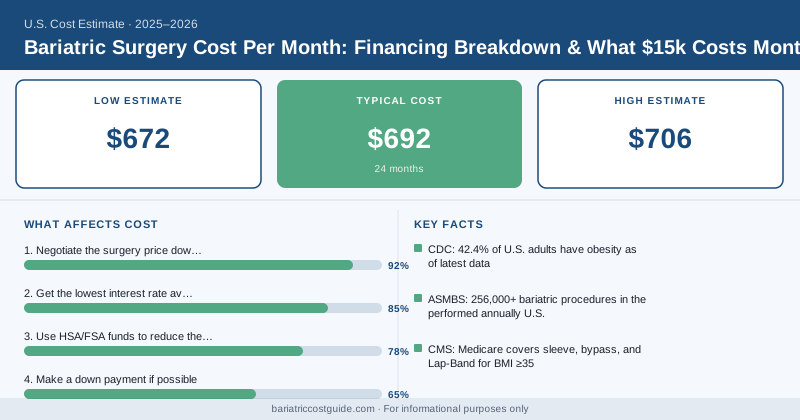
| 24 months | $672/mo | $678/mo | $692/mo | $706/mo |
| 36 months | $463/mo | $470/mo | $484/mo | $498/mo |
| 48 months | $359/mo | $366/mo | $380/mo | $395/mo |
| 60 months | $297/mo | $304/mo | $319/mo | $334/mo |
| 84 months | $225/mo | $233/mo | $249/mo | $266/mo |
At 8% APR over 60 months, the total interest paid is $3,249 — bringing total cost from $15,000 to $18,249.
Gastric Bypass (RYGB): $20,000 Financed
| Loan Term | APR 7% | APR 8% | APR 10% | APR 12% |
|---|---|---|---|---|
| 24 months | $896/mo | $904/mo | $922/mo | $941/mo |
| 36 months | $617/mo | $626/mo | $645/mo | $664/mo |
| 48 months | $479/mo | $488/mo | $507/mo | $527/mo |
| 60 months | $396/mo | $405/mo | $425/mo | $445/mo |
| 84 months | $300/mo | $310/mo | $332/mo | $355/mo |
$25,000 Financed (High-Cost Markets or Duodenal Switch)
| Loan Term | APR 7% | APR 8% | APR 10% | APR 12% |
|---|---|---|---|---|
| 36 months | $772/mo | $782/mo | $806/mo | $830/mo |
| 60 months | $495/mo | $507/mo | $531/mo | $556/mo |
| 84 months | $375/mo | $388/mo | $415/mo | $444/mo |
The Monthly Cost With Insurance
If your insurance covers bariatric surgery and your out-of-pocket is your deductible plus coinsurance, the numbers are much smaller:
| Out-of-Pocket Amount | 12-Month 0% Plan | 24-Month 0% Plan | 8% APR / 36 Mo |
|---|---|---|---|
| $2,000 | $167/mo | $83/mo | $63/mo |
| $4,000 | $333/mo | $167/mo | $125/mo |
| $6,000 | $500/mo | $250/mo | $188/mo |
| $8,000 | $667/mo | $333/mo | $251/mo |
For many insured patients, the monthly cost of financing the out-of-pocket portion is manageable — particularly when stacked against the medication cost savings from diabetes remission and hypertension resolution.
How to Reduce Your Monthly Cost
1. Negotiate the surgery price down first
Before worrying about interest rate, reduce the principal. Many bariatric surgery centers offer 20–40% discounts for self-pay patients. A 30% discount on $22,000 surgery = $15,400 financed instead of $22,000. At 8% APR over 60 months, that’s $312/month vs. $446/month — a $134/month savings for the full term.
2. Get the lowest interest rate available
Rate makes a significant difference over a long term. At $20,000 over 60 months:
- 7% APR: $396/month ($3,741 total interest)
- 10% APR: $425/month ($5,496 total interest)
- 15% APR: $476/month ($8,592 total interest)
- 29.99% APR (CareCredit missed deadline): $632/month ($17,903 total interest)
Check credit unions and LightStream before accepting the financing at your surgical center. See our bariatric surgery loans guide for lender comparisons.
3. Use HSA/FSA funds to reduce the financed amount
If you have $3,000 in an HSA, that’s $3,000 less you need to finance. At 8% APR over 60 months, $3,000 less principal = $61/month less in payments, plus you avoid the interest on that $3,000 ($649 in interest over 5 years). HSA/FSA funds are also pre-tax, so their real value is higher than face value.
4. Make a down payment if possible
If you have any savings, a down payment reduces principal and thus monthly payments. Don’t deplete emergency savings, but 10–20% down can meaningfully reduce monthly obligations.
5. Choose the right term length
Longer term = lower monthly payment but more total interest. Shorter term = higher monthly payment but less interest. The optimal term is the shortest one where the monthly payment is comfortably within your budget with a margin for error.
Build in a Buffer
Monthly Cost Compared to What Surgery Replaces
The real question isn’t “can I afford $304/month?” — it’s “what am I currently spending that surgery would eliminate?”
| Current Monthly Medical Costs | Monthly Loan Payment (5 yr / 8% / $15K) | Net Monthly Change |
|---|---|---|
| Diabetes meds only: $200/month | $304/month | +$104/month (year 1) |
| Diabetes + HTN meds: $350/month | $304/month | -$46/month (net savings from day 1) |
| Diabetes + HTN + apnea: $500/month | $304/month | -$196/month net savings |
| Insulin + multiple meds: $700/month | $304/month | -$396/month net savings |
If you’re currently spending $350–$700/month on obesity-related medications and medical care, the loan payment is not an added cost — it replaces a larger existing cost, with a payoff date. Your medication bills don’t have a payoff date.
The Total Five-Year Picture
For a self-pay gastric sleeve patient at $15,000, financing at 8% APR over 60 months:
- Monthly payment: $304
- Total paid over 5 years: $18,249
- Total interest: $3,249
- Estimated medication savings (diabetes + HTN remission): $4,200–$8,400/year
- 5-year medication savings: $21,000–$42,000
- Net 5-year position: +$2,750 to +$23,750 ahead compared to no surgery
For a full 5-year ROI analysis including mortality reduction, quality of life data, and the GLP-1 comparison, see our bariatric surgery worth it cost analysis.
What This Looks Like Over Time
Year 1: You’re paying $304/month on the loan AND you’ve probably come off some medications (first-year savings maybe $2,000–$4,000). Net cost above pre-surgery baseline is small.
Year 2: Medication savings fully realized for most patients with T2DM and HTN remission. You’re saving more on medications than the loan costs. Net monthly position is positive.
Years 3–5: Still paying the loan at $304/month, but still saving $350–$700/month on medications. Net monthly benefit grows.
Year 6+: Loan is paid off. Medication savings continue. Every month from here on is pure net savings compared to the alternative.
The math works. The monthly cost is lower than most people assume, the offset from medication savings is higher than most people account for, and the long-term trajectory is strongly positive for patients with significant obesity-related comorbidities.
{ if eq .Lang "zh" }Disclaimer: BariatricCostGuide provides cost data for educational purposes only. We are not a medical provider, insurance company, or financial advisor. All costs are estimates based on published data and vary by location, facility, surgeon, insurance plan, and individual health factors. Consult a board-certified bariatric surgeon and your insurance carrier for personalized medical and cost advice.