Bariatric Surgery Center of Excellence Cost: MBSAQIP Accreditation Explained
{ if eq .Lang "zh" }{ else }{ end }Your insurance policy says you need surgery at a “Bariatric Surgery Center of Excellence.” You call your local hospital. They say they’re accredited. You call your surgeon’s independent practice. They say they’re also accredited. Now you’re trying to figure out what any of this means — and whether it changes your cost.
It might. Here’s the breakdown.
What MBSAQIP Accreditation Actually Is
The Metabolic and Bariatric Surgery Accreditation and Quality Improvement Program (MBSAQIP) is a joint program of the American College of Surgeons (ACS) and the ASMBS. It replaced the older Bariatric Surgery Centers of Excellence designation in 2012.
Accreditation levels:
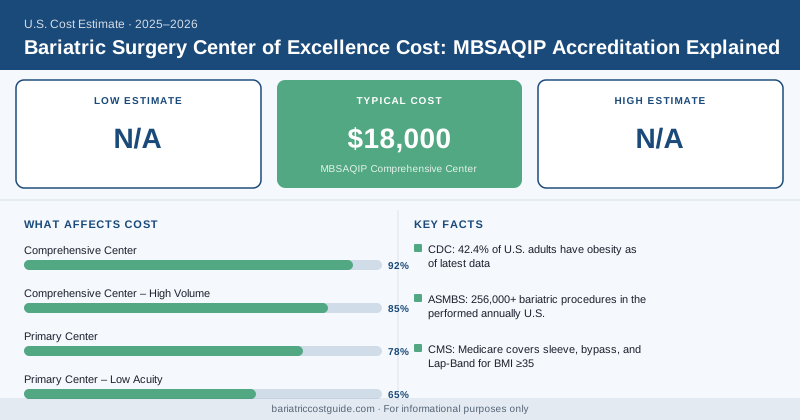
- Comprehensive Center: Full-service program, all procedures including revision and high-complexity cases
- Comprehensive Center – High Volume: 125+ cases/year with enhanced resource requirements
- Primary Center: Lower-complexity cases, standard BMI patients, limited to sleeve and bypass only
- Primary Center – Low Acuity: Outpatient/ambulatory procedures, lower-complexity patients only
In 2024, MBSAQIP reported approximately 950 accredited facilities across the US performing over 256,000 bariatric procedures annually.
| Center Type | Typical Cost Range | Insurance Acceptance |
|---|---|---|
| MBSAQIP Comprehensive Center | $18,000 – $35,000 | Required by most major insurers |
| MBSAQIP Primary Center | $14,000 – $28,000 | Accepted by most insurers |
| Non-accredited facility | $10,000 – $22,000 | May not be covered by insurance |
| Outpatient/ambulatory accredited | $11,000 – $20,000 | Growing insurer acceptance |
Does Accreditation Actually Improve Outcomes?
The evidence is mixed but generally supportive for high-volume centers.
A 2010 JAMA study (the landmark Michigan study) found bariatric surgery complication rates were significantly lower at high-volume facilities. Specifically, the 30-day mortality rate was 0.3% at low-volume facilities versus 0.1% at high-volume facilities — a meaningful difference when you’re the patient.
A 2019 systematic review in Surgery for Obesity and Related Diseases found MBSAQIP-accredited centers had lower complication rates, shorter hospital stays, and better 30-day readmission rates compared to non-accredited facilities for the same procedures.
The ASMBS position: accreditation ensures program infrastructure — 24/7 ICU access, behavioral health support, dietary counseling, multidisciplinary team — that correlates with better outcomes regardless of individual surgeon skill.
What accreditation doesn’t guarantee: individual surgeon volume or technique. You can have surgery at an MBSAQIP Comprehensive Center with a surgeon who performs 20 procedures per year and a non-accredited center’s surgeon who performs 150. Accreditation ensures institutional quality; it doesn’t standardize individual surgeon performance within that institution.
What to Look for Beyond the Accreditation Certificate
Accreditation is a floor, not a ceiling. These factors predict outcomes better than accreditation status alone:
Surgeon annual volume. The ASMBS recommends at least 50 bariatric procedures per year per surgeon as a minimum competency threshold. Higher-volume surgeons (100+ annually) consistently show better outcomes in published data.
Program-level data. Ask the program for their specific complication rates, leak rates, and 30-day readmission rates. MBSAQIP tracks this data — accredited programs can provide it. If they won’t share it, that’s informative.
Revision capability. Does the program handle complications in-house, or will you be transferred to another facility? A program that manages its own complications produces better rescue outcomes.
Multidisciplinary team. Verify the program includes dietitian support, behavioral health, and bariatric medicine for post-op management — not just the surgical team.
Insurance Requirements for Accreditation
Many commercial insurers specifically require MBSAQIP accreditation as a condition of coverage. This is written into the policy benefit language — not a guideline, but a hard requirement.
Major insurers with explicit MBSAQIP requirements (verify your specific plan):
- UnitedHealthcare
- Aetna
- Cigna
- Blue Cross Blue Shield (most regional plans)
- Anthem
- Humana (some plans)
Medicare doesn’t directly require MBSAQIP accreditation — Medicare has its own national coverage determination that allows bariatric surgery at approved facilities, which has overlapping but not identical criteria.
If you choose a non-accredited facility and your policy requires accreditation, your claim can be denied in full. This is the main financial reason accreditation matters for insured patients — a denied claim at a non-accredited facility can leave you with a $20,000–$35,000 bill.
The Cost Premium Question
MBSAQIP Comprehensive Centers typically cost more than smaller non-accredited programs. The gap is usually $2,000–$8,000 in self-pay pricing. Why:
- Higher overhead for multidisciplinary teams, ICU capability, and program infrastructure
- Higher volume allows more competitive pricing in some markets (offsetting the premium)
- Urban hospital systems often have higher facility fees than suburban or freestanding surgical centers
For insured patients, this premium may not matter — your insurer’s contracted rate with the facility determines your cost sharing, not the facility’s list price.
Finding an MBSAQIP-Accredited Program
The MBSAQIP program locator is available on the ACS website. Enter your zip code to find accredited centers near you, with their specific accreditation level.
When comparing programs, ask:
- What is your specific accreditation level (Comprehensive vs. Primary)?
- What is your annual procedure volume?
- Can you share your program’s 30-day complication and readmission rates?
- Is my surgeon credentialed through this program?
Bottom Line
MBSAQIP accreditation at a Comprehensive Center typically adds $2,000–$8,000 in facility costs — but it’s required by most major insurers and correlates with meaningfully better complication rates at high-volume centers. For insured patients, choosing a non-accredited facility risks full claim denial. For self-pay patients, the accreditation premium is worth it for complex cases, high BMI, or first-time procedures; Primary Center accreditation is sufficient for lower-complexity standard procedures. Accreditation is the institutional minimum — also verify your specific surgeon’s annual volume and program complication rates before committing.
{ if eq .Lang "zh" }Disclaimer: BariatricCostGuide provides cost data for educational purposes only. We are not a medical provider, insurance company, or financial advisor. All costs are estimates based on published data and vary by location, facility, surgeon, insurance plan, and individual health factors. Consult a board-certified bariatric surgeon and your insurance carrier for personalized medical and cost advice.