Anthem Bariatric Surgery Coverage: What Elevance Health Covers in 2026
{ if eq .Lang "zh" }{ else }{ end }Anthem — now officially Elevance Health, though most members still see “Anthem” or “Anthem Blue Cross Blue Shield” on their cards — is one of the largest health insurers in the US, with coverage in 14 states. If you’re trying to get bariatric surgery approved through Anthem, here’s what matters: the clinical criteria are mostly standardized, but whether your specific employer plan actually covers bariatric surgery is a separate question entirely — and many don’t.
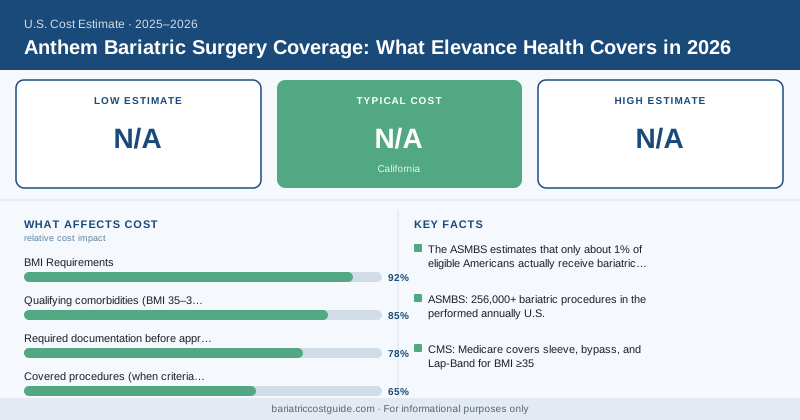
The ASMBS estimates that only about 1% of eligible Americans actually receive bariatric surgery each year, despite 250,000+ procedures performed annually. Insurance barriers — including plans that exclude bariatric coverage entirely — are one of the main reasons that gap exists. Understanding exactly what Anthem does and doesn’t cover is where you need to start.
Anthem States: Where This Coverage Applies
Anthem Blue Cross Blue Shield operates in: California, Colorado, Connecticut, Georgia, Indiana, Kentucky, Maine, Missouri, Nevada, New Hampshire, New York, Ohio, Virginia, and Wisconsin. In some states, the brand is “Anthem Blue Cross” (California) rather than “Anthem BCBS.”
| State | Anthem Brand | Notes |
|---|---|---|
| California | Anthem Blue Cross | Major individual and group market |
| Georgia | Anthem BCBS | Competes with standalone BCBS of GA |
| Indiana | Anthem BCBS | Dominant insurer in state |
| Ohio | Anthem BCBS | Competes with Medical Mutual |
| Virginia | Anthem BCBS | CareFirst BCBS in DC suburbs |
| New York | Empire BCBS (Anthem) | Empire BlueCross is the Anthem affiliate |
| Colorado | Anthem BCBS | Denver market |
| All other Anthem states | Anthem BCBS | Same benefit structure, state variations |
Anthem vs. Other BCBS Affiliates
Anthem’s Standard Bariatric Surgery Coverage Criteria
Anthem’s Medical Policy for bariatric surgery (policy number SURG.00029) sets out the following standard clinical criteria:
BMI Requirements:
- BMI ≥ 40 (Class III obesity), or
- BMI ≥ 35 with one or more serious obesity-related comorbidities
Qualifying comorbidities (BMI 35–39.9):
- Type 2 diabetes mellitus
- Obstructive sleep apnea (documented by sleep study)
- Hypertension requiring treatment
- Hyperlipidemia
- Cardiovascular disease
- GERD (severe/erosive, or requiring medication)
- Osteoarthritis significantly affecting function
Required documentation before approval:
- Documented participation in a physician-supervised weight management program (typically 3–6 months, with monthly visits)
- Psychological/psychiatric evaluation and clearance letter
- Nutritional evaluation by an RD
- Complete medical history and physical exam within 90 days of authorization request
- Documentation of failed non-surgical weight loss attempts
Covered procedures (when criteria are met):
- Gastric sleeve (sleeve gastrectomy / VSG)
- Roux-en-Y gastric bypass
- Biliopancreatic diversion with duodenal switch (BPD-DS)
- Laparoscopic adjustable gastric banding (in limited situations)
- Revisional procedures when criteria are met
State-by-State Variations
Anthem’s coverage varies by state in meaningful ways, driven by state insurance mandates:
California (Anthem Blue Cross): California state law (Insurance Code Section 10123.68) requires fully-insured plans to cover morbid obesity treatment including surgery when medically necessary. This mandate applies to fully-insured plans. Self-insured employer plans (common with large CA companies) are exempt under ERISA.
Indiana: Indiana has no state mandate for bariatric coverage. Fully-insured plans in Indiana can legally exclude bariatric surgery. Check your plan document specifically.
Virginia: Virginia passed legislation requiring coverage for FDA-approved obesity treatments, effective 2022, for fully-insured plans. This includes medications and surgery. Virginia has one of the more favorable coverage environments for Anthem BCBS members.
New York (Empire BCBS): New York state law requires coverage for bariatric surgery in fully-insured plans when medically necessary. Empire (Anthem’s NY affiliate) covers bariatric surgery broadly for qualifying members.
Georgia: No state mandate. Anthem BCBS of Georgia plans can exclude bariatric coverage. This is particularly impactful given Georgia’s high obesity rate. Always verify your specific plan.
Colorado: No explicit mandate beyond ADA essential health benefits. Anthem BCBS CO covers bariatric surgery on most plans but it’s not universally guaranteed.
The Supervised Weight Loss Requirement
Anthem typically requires 3–6 months of medically supervised weight management documentation. Here’s what that means practically:
- Monthly visits with a physician who documents your weight, BMI, dietary counseling, and attempts at weight loss
- Visits should be with an MD or DO (not just a dietitian alone in most cases)
- The program must be documented in your medical record — not a commercial weight loss program like Weight Watchers or Noom (unless a physician is directly involved and billing medically)
- Some Anthem plans accept a formal medically supervised program; others want primary care documentation
The 3-month vs. 6-month distinction matters. Anthem’s policy states 3–6 months, but your specific plan may specify one or the other. Plans in more regulated states (NY, VA, CA) tend to accept 3 months; plans in states with less regulation sometimes require 6. Ask your bariatric surgery coordinator to confirm what your specific plan requires before you start your documentation period.
Center of Excellence Requirement
Many Anthem employer plans require bariatric surgery to be performed at an MBSAQIP (Metabolic and Bariatric Surgery Accreditation and Quality Improvement Program) accredited Center of Excellence. This isn’t a universal Anthem requirement — it’s a plan-level benefit design choice that employers opt into.
If your plan requires a Center of Excellence, verify that your preferred surgeon and hospital both hold MBSAQIP accreditation before getting any pre-op workup. You can verify accreditation at the MBSAQIP website directly.
| Authorization Requirement | Anthem Standard Policy |
|---|---|
| Prior authorization required | Yes — all bariatric procedures |
| Supervised weight loss | 3–6 months (plan-specific) |
| Psychological evaluation | Yes |
| Nutritional evaluation | Yes |
| Center of Excellence required | Plan-dependent (not universal) |
| Annual deductible applies | Yes — varies by plan |
| Out-of-pocket maximum applies | Yes |
Getting Authorized: The Step-by-Step Process
Confirm coverage exists. Call Anthem, ask if bariatric surgery is a covered benefit under your plan, and get a reference number. Also ask if a Center of Excellence is required.
Choose a participating bariatric program. Find an MBSAQIP-accredited program in the Anthem network. Your program’s bariatric coordinator will be your guide through the authorization process — they do this daily.
Complete the supervised weight loss period. Typically monthly visits with your PCP or the bariatric program’s physician for 3–6 months. Documentation must be in your medical chart.
Complete required evaluations. Psychological clearance, nutritional assessment, and any specialty consults (cardiology, pulmonology, etc.) as required by the program or Anthem.
Bariatric coordinator submits prior auth. The bariatric surgery program submits the prior authorization package to Anthem. Allow 2–4 weeks for review. Anthem’s standard timeline is 15 business days for non-urgent pre-authorization.
Receive authorization letter. Do not schedule surgery until you have written authorization. Surgery performed without authorization will typically be denied entirely, not just partially covered.
If denied, you have the right to appeal. Anthem denials can be appealed at the first, second, and external review levels. Many initial denials are overturned on appeal — especially when a physician submits a peer-to-peer review call with the Anthem medical director.
Anthem and Anti-Obesity Medications
Anthem’s formulary covers FDA-approved weight loss medications — Wegovy, Zepbound, Saxenda, Qsymia, and Contrave — on many plans, but the same employer exclusion issue applies. Plans that exclude bariatric surgery often also exclude anti-obesity medications. If your plan covers neither, you’re looking at self-pay medication costs or self-pay surgical costs.
What Anthem Doesn’t Cover
Even when bariatric surgery itself is covered, these are typically excluded:
- Body contouring procedures after weight loss (panniculectomy, arm lift, thigh lift) — cosmetic exclusion
- Cosmetic revisions
- Weight loss medications if not on the plan formulary
- Nutritional supplements post-surgery (vitamins, protein shakes)
- Non-MBSAQIP facilities if your plan has a Center of Excellence requirement
- Surgery performed outside the Anthem network without prior authorization
See the body contouring after bariatric cost guide for what those out-of-pocket costs look like if you’re planning for the full treatment journey.
Bottom Line
Anthem covers bariatric surgery with standard clinical criteria — BMI ≥ 40 or ≥ 35 with comorbidities, plus a supervised diet period, psychological evaluation, and nutritional clearance. The critical variable is whether your specific employer plan includes bariatric coverage at all. That single question — does my plan cover this? — should be your first call. State mandates in Virginia, New York, and California offer stronger protections; Indiana, Georgia, and others have no mandate. Your bariatric surgery coordinator will manage the authorization paperwork, but the benefit verification is on you.
{ if eq .Lang "zh" }Disclaimer: BariatricCostGuide provides cost data for educational purposes only. We are not a medical provider, insurance company, or financial advisor. All costs are estimates based on published data and vary by location, facility, surgeon, insurance plan, and individual health factors. Consult a board-certified bariatric surgeon and your insurance carrier for personalized medical and cost advice.